

Of what use were the arts if they were only the reproduction and the imitation of life?
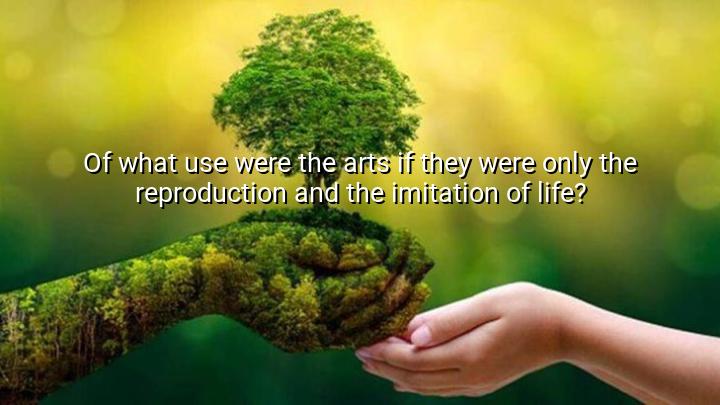




The quote "Of what use were the arts if they were only the reproduction and the imitation of life?" by Alfred de Vigny challenges the notion that the arts should simply mirror or replicate the world as it is. De Vigny, a French poet and playwright, suggests that if art were limited to merely copying life, it would lack depth and purpose. The value of art lies not in reproduction, but in its ability to transform, interpret, and offer new perspectives on life, revealing deeper truths and emotions beyond surface appearances.
De Vigny’s quote encourages artists to go beyond imitation and to use their work to explore complex themes, express personal experiences, and evoke emotions. Rather than just reproducing what is seen, art has the power to convey ideas, challenge perceptions, and provoke thought. This is why art is not merely a reflection of reality, but a vehicle for creativity and interpretation, offering something new that enriches the viewer’s understanding of the world.
The quote also suggests that the arts have a higher calling than simple reproduction. Artists are not just observers but creators who shape and redefine their surroundings through their vision and skills. By emphasizing the creative transformation of life, rather than its direct duplication, De Vigny speaks to the enduring power of art to elevate the human experience beyond the mundane.
Ultimately, this quote reflects De Vigny’s belief that art should have a transformative role in society. It is not enough for artists to imitate what already exists; they must strive to offer fresh interpretations that inspire, challenge, and move their audiences. Art, in De Vigny’s view, becomes truly meaningful when it goes beyond mere reproduction and instead offers a deeper, more personal engagement with the essence of life.

TBThu Bao
This quote kind of puts pressure on artists to innovate constantly. Is that fair? What if some creators find meaning in capturing the quiet, ordinary details of life? Is that inherently less valuable than inventing something new? I’m torn—while I admire bold, imaginative work, I also think there’s deep emotional resonance in well-done, honest depictions of life. Maybe the ‘use’ of art can be both imitation and interpretation.
TTThanh Tran
De Vigny’s quote makes me think about how art can serve as both a reflection and a rebellion against reality. If it’s only mimicking life, then it risks being static or safe. But when it reshapes reality, it invites us to question norms, challenge beliefs, or dream beyond the possible. Could this be why movements like surrealism or abstract expressionism felt so revolutionary?
NNNgoc Nguyen
I actually feel conflicted reading this quote. On one hand, I get the point—art should do more than reflect. But on the other, imitation can be incredibly moving. Think of theater re-enacting historical events or films that portray personal tragedies. Isn't there power in simply holding up a mirror to life? Maybe the deeper question is what the artist *adds* to the imitation—emotion, critique, or a new lens.
DHDung hoang
This makes me wonder about photography, especially documentary work. If the arts are devalued by imitation, where does that leave artists who aim to capture reality as truthfully as possible? Is it the intention behind the work that matters more than the technique? I’d love to hear from people who work in realism—how do you infuse originality and meaning when you're working so close to real life?
HNNguyen Hien Nhi
I feel like this quote hits at the core of why art exists. Is its purpose really just to mirror life, or should it reveal something deeper, something we can’t see in our day-to-day experiences? Maybe art should provoke, elevate, or even distort life to help us understand it better. But then, where do we draw the line between imitation and expression? Can art ever truly separate from life?