

No man can think clearly when his fists are clenched.
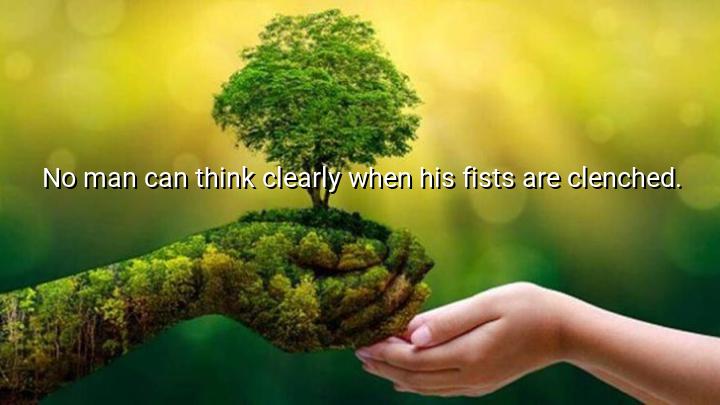




In this quote, George Jean Nathan illustrates the idea that anger or frustration, symbolized by clenched fists, clouds a person's ability to think clearly. When we are emotionally charged or tense, like when our fists are clenched, our focus shifts from rational thought to emotional reaction. This creates a mental block, preventing us from processing information or responding with logic. Nathan is emphasizing that, in such states, we are unable to make thoughtful decisions or understand the situation clearly.
The phrase "fists are clenched" is a metaphor for physical and emotional tension. It represents the body’s automatic response to anger or stress, where our muscles tighten, and our emotions take over. Nathan’s quote suggests that when we are physically tense, we cannot access our calm or rational mind. It is only when we release this tension, both mentally and physically, that we regain the clarity needed for effective problem-solving and decision-making.
Nathan, known for his sharp commentary and observations on human nature, often explored the complexities of emotion and reason. His quote reflects a deeper understanding of how emotional states can dominate and inhibit clear thinking. By using the image of clenched fists, he highlights the physical manifestation of anger and reminds us that emotional control is necessary to think with clarity.
Ultimately, the quote serves as a reminder that emotional awareness is key to maintaining rationality. In times of stress or anger, we must strive to release physical tension and create space for calm thinking. By doing so, we can approach problems with a more level-headed perspective, rather than being driven solely by our emotions.

HHhao huy
It’s powerful how this quote links physical posture with mental state. Could it mean that by changing our body language—relaxing our fists—we might actually influence our thinking positively? Does this hint at a mind-body connection where physical relaxation leads to mental calm? How might this be applied practically, for example in therapy or daily stress management, to improve decision-making?
TP25-Le Tan Phat
From a psychological perspective, this quote suggests that anger can hijack our cognitive functions. I wonder how this aligns with studies on fight-or-flight responses. Does the tension implied by clenched fists trigger a survival mode that limits rational thought? Also, could this insight help in teaching emotional regulation, especially in high-stress environments like negotiations or crises?
TTnang khieu the duc the thao
This makes me think about situations where people react impulsively—does the physical act of clenching fists represent a broader inability to stay calm under stress? Could mindfulness or other calming practices literally open the door to clearer thinking? On the flip side, could suppressing natural emotional responses also have downsides? It raises a question about balance between expression and control.
TDPhan Thi Thuy Dung
I can’t help but feel this speaks to the importance of emotional control in communication. But what about moments when anger is justified and even necessary? Can someone still think clearly when passionate, or does any form of strong emotion cloud judgment? How do we distinguish between productive passion and destructive anger, and what role does self-awareness play in that?
TVTuan Vo
It’s interesting to think about the physical metaphor here—clenched fists symbolizing a closed mindset. Does this mean that emotional tension literally blocks clear thinking? If so, what techniques are best for ‘unclenching’ mentally and physically to regain clarity? Could this also relate to how stress affects the brain’s ability to process information? I’d love to hear perspectives on how this manifests in conflict resolution.