

Myth and fairy-story must, as all art, reflect and contain in solution elements of moral and religious truth (or error), but not explicit, not in the known form of the primary 'real' world.
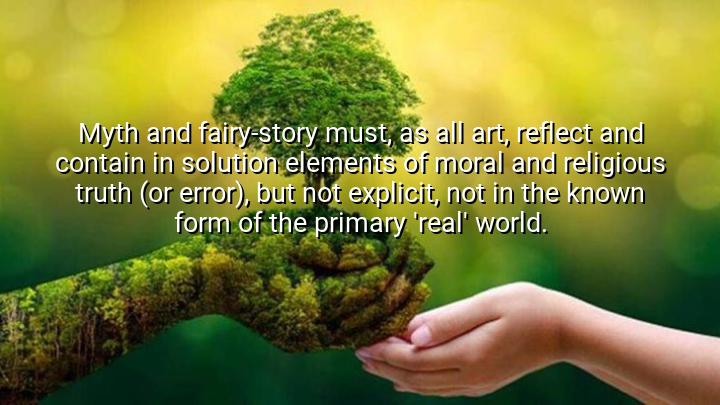




In this quote, J. R. R. Tolkien argues that myth and fairy-story are forms of art that contain elements of moral and religious truth, but these truths are not conveyed in a direct or explicit manner. Instead, they are presented in a way that is more symbolic or allegorical, often through fantastical settings and characters. Tolkien suggests that art—specifically myth and fairy stories—has the unique ability to address deeper truths about the human experience, but these truths are woven into a narrative that is separate from the "real" world, allowing for a more imaginative exploration of ideas.
Tolkien emphasizes that these stories should not present moral or religious teachings in the straightforward way that traditional religious or philosophical texts might. Instead, the truths in myth and fairy stories are often veiled in fantasy, providing a layer of abstraction that makes them more universal and timeless. This approach allows for a richer engagement with the themes and values that these stories explore, inviting readers to reflect on them in a more personal and imaginative way.
The origin of this quote can be found in Tolkien's broader views on mythology and its role in literature and culture. As a scholar of ancient languages and myth, Tolkien deeply understood the power of myth to convey complex truths through metaphor and storytelling. His works, such as The Lord of the Rings, are prime examples of how fantasy can reflect deep moral and existential questions while remaining detached from the specific realities of the modern world.
Through this quote, Tolkien invites us to appreciate the deeper moral and religious elements embedded within art like myth and fairy-stories. By transcending the boundaries of the "real" world, these stories offer a space for reflection on universal truths, encouraging readers to engage with these ideas in a way that is both imaginative and meaningful.

TNLe the ngoc
There’s something profound in how Tolkien separates myth from the 'known form' of reality. It makes me think about why people connect so deeply with fantastical stories. Do you think myths resonate more because they bypass the conscious mind and appeal to something older, maybe even primal? Is that why their truths feel so universal even across cultures?
VMVuong Minh
Tolkien's statement seems to advocate for metaphor over didacticism. That’s beautiful, but is it limiting? Sometimes, especially in turbulent times, don’t we need stories to be more explicit about their truths? Can subtle myth alone stand up to loud misinformation or harmful ideologies? Or is the quiet approach more lasting and persuasive in the end?
BDBaoanh Do
I love how Tolkien acknowledges that stories should carry moral and religious elements in a subtle way. But can this indirect method be powerful enough to influence people’s real-world values? Or do we risk the message being too obscure or lost entirely? I’d be interested in examples where a fairy tale changed someone’s worldview without preaching directly.
MNManh Nguyen
This quote makes me think about how modern storytelling has shifted. Are today's fantasy and myth-based stories still conveying moral and spiritual insights, or are they mostly focused on entertainment and spectacle? Tolkien implies a kind of responsibility on the part of the artist, but do creators today still carry that torch—or even believe it matters?
QTpham ngoc quynh trang
Tolkien’s perspective is fascinating because it suggests that myth and fairy tales aren’t just for children or escapism—they’re vessels for deep truths. But I’m left wondering: how do we differentiate between the truth embedded in myth and the moral lessons imposed by the storyteller? Is it possible for readers to misinterpret the intended values because they’re too subtly embedded in the narrative fabric?