

My friends, love is better than anger. Hope is better than fear. Optimism is better than despair. So let us be loving, hopeful and optimistic. And we'll change the world.
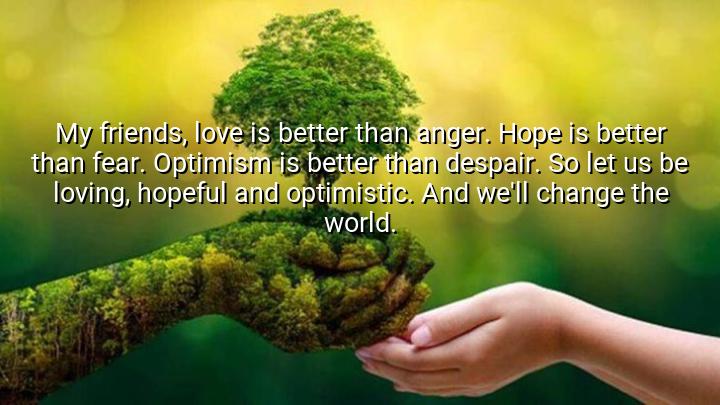




In this quote, Jack Layton emphasizes the power of positive emotions—love, hope, and optimism—as forces for personal and social transformation. He suggests that love is a more effective and enriching response than anger, hope is more constructive than fear, and optimism leads to better outcomes than despair. Layton argues that by embodying these positive qualities, individuals can help change the world, fostering a more compassionate and hopeful society.
Layton's message is a call to focus on the uplifting emotions that inspire action and growth. Anger, fear, and despair are often paralyzing and divisive, while love, hope, and optimism encourage unity, progress, and resilience. By choosing to embody these virtues, Layton believes we can overcome challenges and build a better future for everyone. His quote reflects a deep belief in the transformative potential of positivity and the importance of choosing constructive attitudes in difficult times.
As a Canadian politician and social activist, Layton was known for his emphasis on social justice and community values. His leadership focused on creating positive change through inclusivity, cooperation, and compassion. This quote encapsulates his worldview that societal progress comes not from dwelling on negative emotions, but by cultivating hope and love in the face of adversity. His appeal for a more loving, hopeful, and optimistic world was a central theme of his political and personal philosophy.
Ultimately, Layton’s quote serves as a reminder that attitude and perspective play a significant role in shaping both our personal lives and the broader world. By choosing positive emotions over negative ones, we not only improve our own well-being but also contribute to creating a more hopeful and inclusive society. Through love, hope, and optimism, we have the power to create lasting change.

TCDo Pham Thanh Cong
The optimism in this quote is contagious and motivating. It suggests that emotional choices have collective power. I’m curious about psychological research on how love, hope, and optimism influence social movements or policy changes. Can these emotions inspire sustained activism, or do they need to be paired with strategic action to be effective?
TSNguyen Trung Son
This quote resonates deeply in today’s polarized world. It makes me think about the transformative potential of adopting love and hope as guiding principles. But I wonder how cultural differences shape the expression of these emotions. Are there societies where optimism is less common, and how does that affect their approach to change?
JVjanny Vu
Reading this, I feel both comforted and challenged. It’s easy to say love is better than anger, but how do we cultivate love when we face betrayal or cruelty? Does this mean suppressing justified anger? The quote encourages positivity, but I wonder how to integrate difficult emotions into this framework in a healthy way.
THThu Huyen
This statement feels like a call to action grounded in emotional intelligence. It makes me curious about how communities can foster love, hope, and optimism collectively. What role do leadership and education play in promoting these values? Can such a mindset shift actually overcome systemic problems like inequality and injustice?
TNThu Nga
I love the uplifting message here, but it also makes me question how realistic it is to maintain hope and optimism in the face of serious global issues. Are these attitudes enough to drive real change, or do we also need to acknowledge fear and despair as motivators? How can we stay hopeful without becoming naive or complacent?