

Many churches are measuring the wrong things. We measure things like attendance and giving, but we should be looking at more fundamental things like anger, contempt, honesty, and the degree to which people are under the thumb of their lusts. Those things can be counted, but not as easily as offerings.
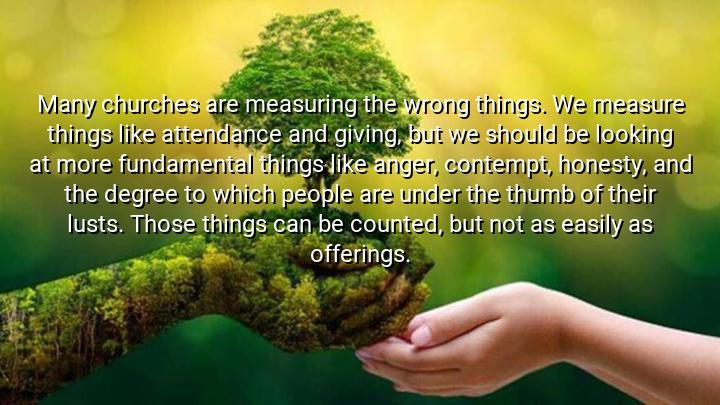




In this quote, Dallas Willard critiques the way many churches measure success, suggesting that they focus too much on superficial metrics like attendance and giving. He argues that these indicators are not truly reflective of a congregation’s spiritual health. Instead, Willard proposes that churches should shift their focus to more profound and internal aspects of a person's character, such as anger, contempt, honesty, and the degree to which individuals are controlled by their lusts. These, he suggests, are the true markers of spiritual growth, even though they are not as easily measurable as more external factors like financial contributions or the number of people attending services.
Willard’s statement highlights the importance of examining the inner life of individuals within the church, rather than relying solely on quantitative data. He points out that emotions like anger and contempt can indicate deeper issues with a person’s heart and relationship with others, while honesty and self-control over lusts reflect one's integrity and spiritual maturity. These characteristics, though harder to measure, are critical for understanding whether the church is fulfilling its deeper mission of fostering genuine transformation in its members.
The origin of this quote lies in Willard’s long-standing work as a philosopher and theologian, where he often discussed the need for churches to focus on the internal, spiritual aspects of life, rather than external behaviors or numbers. His critique stems from his belief that true spiritual formation involves a transformation of character that cannot be fully captured by simple metrics. Willard’s writings, including his influential book The Divine Conspiracy, emphasize this point, calling for a deeper, more authentic approach to spirituality.
Ultimately, Willard’s quote challenges churches to rethink their priorities and measurement systems. Instead of being fixated on attendance or giving, churches should consider more meaningful indicators of spiritual health, such as the presence of anger and contempt or the ability to live a life marked by honesty and self-control. These aspects are harder to quantify but ultimately more significant in shaping a person’s spiritual journey.

LNXuan Long Nguyen
Reflecting on this quote, I’m curious about the role of accountability within spiritual communities. If less tangible issues like contempt or lust are harder to quantify, how can leaders foster environments where these are openly addressed? Could technological tools or new pastoral practices help? This also touches on whether people want to admit these struggles or if denial keeps the status quo in place.
VQNguyen Van Quan
This statement brings up a tension between quantity and quality in religious life. Measuring offerings and attendance is straightforward but may mask serious internal struggles among members. What if churches developed spiritual wellness check-ins that included honest discussions about anger and honesty? How might that impact community dynamics, and would it lead to greater empathy or judgment? This feels like a call for deeper, more authentic engagement.
TTTu Truong
The idea that fundamental emotional and moral conditions should be measured rather than mere attendance is powerful. But it also seems incredibly complex—how do you objectively assess something like ‘being under the thumb of lust’? Could qualitative approaches like personal testimonies or counseling sessions serve this purpose? It makes me wonder if the discomfort around these topics prevents more honest evaluation in faith communities.
TNLe Nguyen Thu Ngan
I find this perspective quite thought-provoking and somewhat uncomfortable. Are churches prioritizing attendance and donations because those are easy to quantify and report? What might change if leaders instead focused on harder-to-measure traits like anger or contempt? Would congregations resist or embrace such transparency? This raises important questions about the purpose of religious institutions and the nature of true spiritual growth.
Ddnl
This quote challenges conventional metrics in religious communities and makes me question how deeply we truly assess spiritual health. Can intangible qualities like honesty or struggles with lust really be measured in meaningful ways? What tools or frameworks could churches develop to better track these deeper aspects? It seems critical to shift focus from surface numbers to genuine personal transformation, but how realistic is that in practice?