

Man alone is born crying, lives complaining, and dies disappointed.
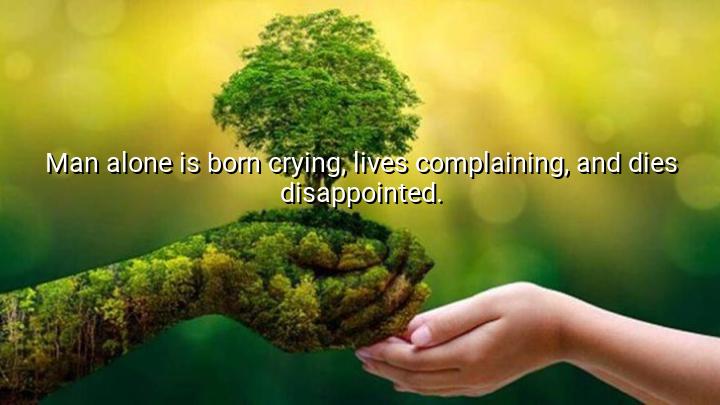




The quote "Man alone is born crying, lives complaining, and dies disappointed." by Samuel Johnson reflects his pessimistic view of the human condition. Johnson, an 18th-century English writer, lexicographer, and philosopher, suggests that human life is inherently marked by suffering and discontent. The image of a baby being born crying implies that from the very start, human existence is linked with pain and difficulty. This cry represents the beginning of a life filled with challenges, where complaint and disappointment are part of the human experience.
Johnson’s statement implies that throughout life, human beings struggle to find contentment or fulfillment. From the cry of a newborn to the complaints of an adult, he suggests that people are constantly dissatisfied with their circumstances, whether it be their health, wealth, or relationships. The phrase "lives complaining" highlights how human nature tends to focus on what is lacking, often failing to appreciate the positive aspects of life. This ongoing struggle contributes to a sense of disillusionment as people age.
The final part of the quote, "dies disappointed", reinforces Johnson’s view that life often ends with unmet expectations and regret. No matter how much one achieves or how far one progresses, there is a sense that the ultimate goal of lasting happiness or peace remains elusive. This idea suggests that human desires are never fully satisfied, and as a result, people face disappointment at the end of their lives.
Ultimately, Johnson’s quote reflects a fatalistic perspective on the human experience, where suffering, complaint, and disappointment are central themes. It highlights the struggle for happiness and the human tendency to feel unsatisfied with life’s outcomes, a sentiment that resonates with those who view life through a lens of realism or skepticism about human nature.

XTDo Xuan Truong
This makes me think about how the quote emphasizes loneliness at birth but shifts to a broader human dissatisfaction later. Is it suggesting that isolation and disappointment are inherent parts of life’s journey? How might connection and community counteract this pattern? It’s a poignant reminder of the complexities and contradictions inherent in human existence.
VYVy Yen
I wonder if this quote reflects a specific historical or cultural context that influenced Johnson’s worldview. Was life more challenging in his time, leading to this pessimistic outlook? How might modern advancements and social changes affect the validity of this statement today? It’s interesting to explore how perspectives on life’s hardships evolve over time.
UGUser Google
Could this statement be read as a commentary on human nature’s tendency toward dissatisfaction and longing? Perhaps Johnson is highlighting a universal restlessness that drives people forward but also causes pain. How does this restlessness impact motivation, creativity, and relationships? This quote makes me consider the paradox of human desire—both a source of growth and of suffering.
HDTrinh Thi Huyen Dieu
This quote makes me question the role of attitude and perspective in human experience. While crying and complaining are common, are they the defining features of life? Could focusing on gratitude and resilience alter this narrative? It invites reflection on how much control we have over our emotional journey and whether disappointment is truly inevitable.
QNQuyen Nguyen
I’m intrigued by the cyclical nature of this statement—birth, life, and death framed through negative emotions. Does this imply that human existence is defined more by struggle than by achievement or contentment? It raises philosophical questions about whether suffering is the default human state, or if this is just one interpretation. How might this view influence how we live and find meaning?