

Like music and art, love of nature is a common language that can transcend political or social boundaries.
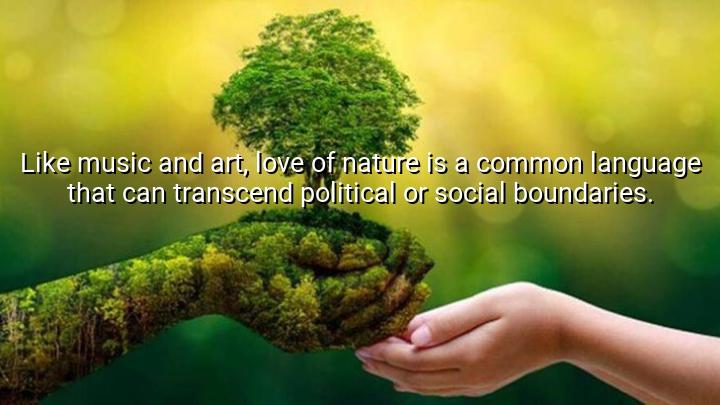




In this quote, Jimmy Carter highlights the universal power of certain forms of expression—such as music, art, and a love of nature—to unite people across political or social boundaries. He suggests that these passions are common languages that can resonate with individuals from different cultures, ideologies, and backgrounds. Just as music and art can evoke emotion and understanding regardless of one’s nationality or beliefs, so too can a shared appreciation for the natural world bridge divides between people.
Carter emphasizes the transcendent nature of these connections, implying that they have the ability to cut through barriers that often separate individuals or groups, such as political conflicts or social divisions. A mutual love for nature, for instance, can inspire collaboration and solidarity even in situations where individuals may otherwise disagree on more contentious issues. By focusing on shared experiences or universal sources of beauty, people are able to find common ground.
The mention of music, art, and nature reflects the idea that these are intrinsic and deeply rooted aspects of the human experience. Each of these has the capacity to stir deep emotions, evoke empathy, and foster understanding. Carter points out that these forms of connection can be powerful in promoting peace and cooperation because they speak directly to the heart, bypassing intellectual or ideological differences.
Ultimately, Carter’s quote speaks to the unifying potential of the natural world and human creativity. It suggests that, despite our differences, there are aspects of life that can bring us together, helping to foster a sense of shared humanity. Whether through the beauty of nature, the expression of music, or the emotional power of art, these universal languages have the capacity to heal and unite.

YNNguyen Yen Nhi
This quote reminds me of how international conservation efforts often unite people from vastly different backgrounds. Think of the global work on climate change or wildlife protection—those efforts rely on shared values beyond borders. But I wonder, is it love of nature that unites them, or the shared urgency of survival? Is that distinction important when we talk about unity through nature?
AB06. Tran An Binh
As someone who finds peace in hiking and birdwatching, I resonate with this quote. Nature really can bring people together, even when they don’t speak the same language. But I’m curious—how do we harness this shared appreciation to actually foster cooperation across political divides? Is it just an emotional connection, or can it be a tool for diplomacy or social change?
GDGold D.dragon
It's a beautiful thought, but I’d like to challenge it: can nature really transcend political and social boundaries when so much of environmental damage disproportionately affects marginalized communities? For example, industrial pollution often harms poor neighborhoods the most. Doesn’t this complicate the idea of a shared love for nature? I think it’s worth asking how we can make this connection more inclusive and equitable.
MTDo Minh Thu
I find this idea comforting, especially in today’s fractured world. There’s something universal about standing in awe of a forest or a mountain. But does everyone really have equal access to nature, or the time to appreciate it? I’d be interested in hearing how cultural or socioeconomic factors influence how people connect to the natural world—can this 'common language' really be spoken by all?
THThinh Huynh
This quote makes me wonder: if love for nature truly transcends political and social boundaries, why do we still see such deep divisions over environmental policies? Is the issue really a lack of shared appreciation, or is it more about conflicting interests and priorities? I like the sentiment, but I’m not sure it reflects the complexity of how people relate to nature in practice, especially when economics or ideology gets involved.