

A fundamentalist can't bring himself or herself to negotiate with people who disagree with them because the negotiating process itself is an indication of implied equality.
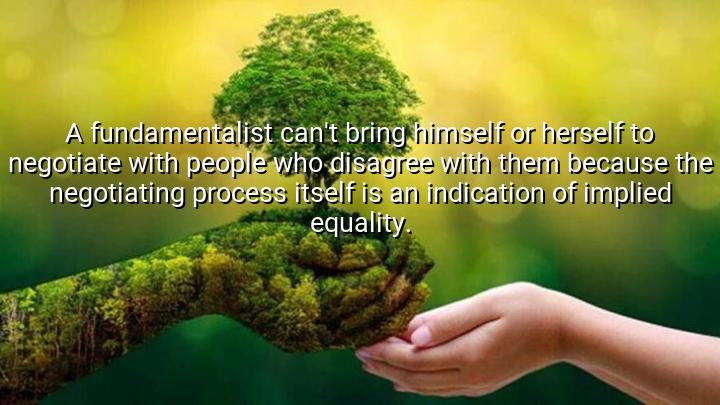




The quote, "A fundamentalist can't bring himself or herself to negotiate with people who disagree with them because the negotiating process itself is an indication of implied equality," comes from Jimmy Carter, the 39th President of the United States and a Nobel Peace Prize laureate. Known for his dedication to human rights, peace, and diplomacy, Carter frequently spoke on issues related to conflict resolution and equality. This quote reflects his perspective on the nature of fundamentalism and its inherent rejection of dialogue with those who hold differing views.
In this statement, Carter highlights that fundamentalists, whether religious or ideological, often struggle with the concept of negotiation because it requires a level of equality between parties. To a fundamentalist, engaging in a negotiating process with someone who holds opposing views implies that the other person’s perspective has value and is worthy of consideration. This is at odds with the fundamentalist’s belief that their own worldview is absolute and non-negotiable, leaving no room for mutual respect or compromise.
The quote suggests that fundamentalism tends to be rigid and non-compromising, as it views disagreement not as an opportunity for understanding or collaboration but as a challenge to its authority. For fundamentalists, the act of negotiating with someone who disagrees undermines their position of moral or ideological superiority, as it implies an acknowledgment of the other side’s equal right to hold and express their beliefs. This is particularly relevant in contexts where religion, politics, or culture play dominant roles in shaping one’s identity.
Ultimately, Carter’s quote sheds light on the barriers to peace and coexistence that arise from fundamentalist thinking. Dialogue and negotiation are essential tools in resolving conflicts, but they are often rejected by those who view any form of compromise as a betrayal of their core beliefs. By emphasizing the role of equality in negotiation, Carter advocates for a more inclusive and open-minded approach to dispute resolution, where differing perspectives are respected and addressed.

AAdministratorAdministrator
Welcome, honored guests. Please leave a comment, we will respond soon