

Layer by layer art strips life bare.
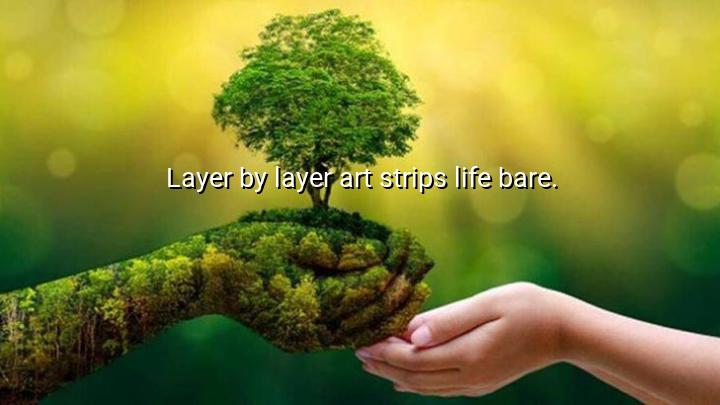




The quote "Layer by layer art strips life bare" by Robert Musil suggests that art has the ability to reveal deeper truths about life through a process of gradual exploration. Just as peeling away layers of an object exposes its core, art strips away the surface details of human existence to uncover the complexities, emotions, and realities beneath. This process allows the artist and the viewer to gain a clearer understanding of the true nature of life, beyond its superficial appearances.
Musil’s statement emphasizes that art is not just a surface-level depiction of the world but a means of delving into the deeper aspects of human experience. The act of creating or experiencing art gradually peels away the layers of illusion, exposing the raw and unfiltered truths of existence. This can involve confronting uncomfortable realities, questioning societal norms, or exploring the inner workings of the human soul. Art becomes a tool for understanding the complexity and depth of life, moving beyond what is immediately visible.
The origin of this quote reflects Musil’s philosophical approach to art and literature. As an Austrian writer known for his intellectual depth, Musil often explored themes of identity, truth, and the human condition in his works. His perspective on art as a tool for uncovering the layers of life aligns with his broader views on the complexity of existence and the need for introspection and critical thought.
By stating that "art strips life bare," Musil underscores the transformative power of art. It is not merely about aesthetic pleasure or decoration but about using creativity to challenge the surface-level perceptions of reality. Through the process of art, we are encouraged to look deeper, uncovering the truths that lie hidden beneath the layers of daily life.

TPThao Phuong
Musil’s quote makes me think of the way great novels, paintings, or films can make you feel like someone just reached into your chest and pulled something out you didn’t know was there. But how do we, as audiences, handle that kind of exposure? Do we engage deeply or protect ourselves with distance and irony? It’s fascinating how the act of 'stripping life bare' can be both a gift and a challenge for viewers.
KLDo Khanh Ly
This quote really challenges the way I think about the role of the artist. If creating art means stripping life bare, does that put artists in the position of emotional archaeologists? Are they obligated to dig deep, even when it hurts? I wonder how this idea sits with artists who work in commercial or entertainment-focused mediums. Can their work still be considered authentic art if it doesn’t strive for this kind of revelation?
TLTran Long
Reading this quote, I’m torn. On one hand, it beautifully captures art’s power to reveal truth. On the other, it seems to put pressure on art to always dig deep. Can’t art sometimes be about adding layers too—creating mystery, complexity, or even protection from the rawness of life? I’d love to hear how others balance this idea of stripping away versus building up in their own artistic experiences.
TNAn Thu Nguyen
What a powerful metaphor. I like the notion of 'stripping life bare' as a process—slow, deliberate, revealing. It makes me think of how abstract art or surreal literature can seem nonsensical at first, but then something deeply human emerges with time. But does this mean that the value of art depends on how much it reveals? Where do aesthetics, playfulness, or imagination fit into this perspective?
HQNguyen Thi Hong Quyen
This idea resonates with me deeply, especially when I think of art that challenges norms or reveals hidden suffering. But I wonder—does all art truly aim to expose life’s essence, or are some works more about escape, fantasy, or beauty for its own sake? Is Musil suggesting that art must always be honest and unflinching, or is he commenting more on the potential of art rather than its purpose?