

All still lifes are actually paintings of the world on the sixth day of creation, when God and the world were alone together, without man!
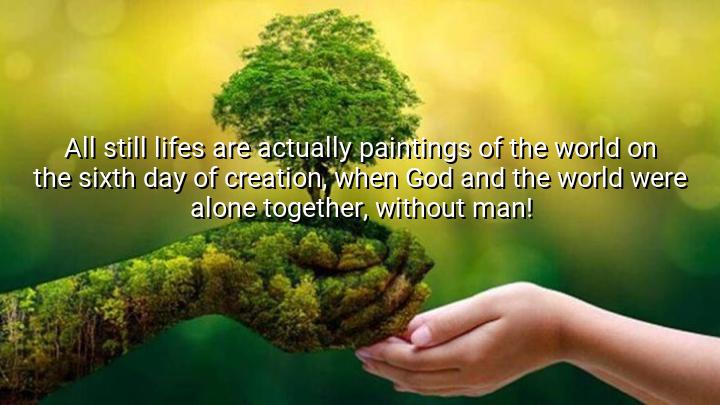




In this quote, Robert Musil, an Austrian writer, reflects on the nature of still life paintings and their deeper significance. He suggests that still life paintings—typically depictions of inanimate objects like fruits, flowers, or everyday items—are symbolic of the world during the sixth day of creation, a moment when God and the world existed in isolation, before the arrival of man. Musil’s comparison implies that these paintings capture the world in its purest, most untainted form, before human influence or interpretation shaped it.
Musil’s statement highlights the absence of man in still life art, suggesting that these works serve as a reminder of a time when the world was undisturbed and in a state of natural harmony. Without human presence, the world is portrayed in its simplest, most direct state. Still life paintings, in this context, become a form of reflection on the world as it might have appeared before it was altered by human experience, culture, and perception.
The origin of this quote lies in Musil's broader philosophical and literary views, particularly his exploration of existence and the nature of reality. Known for his complex and often existential writing, Musil frequently delved into themes of isolation, identity, and the interaction between individuals and the world around them. By comparing still life paintings to the sixth day of creation, Musil invites us to consider how we see the world in its most basic and untouched form, absent of human interpretation or intervention.
In essence, Musil’s quote suggests that still life art is a representation of the world before man, offering a moment of solitude where the natural world exists purely on its own. It speaks to the idea of simplicity and purity, inviting viewers to reflect on the beauty and completeness of the world as it might have been before human involvement.

LNLinh Nguyen
Thinking of still lifes as scenes from a pre-human world raises questions about the interaction between life, art, and spirituality. Does this viewpoint elevate mundane objects into symbols of divine presence? How might this change the way museums curate still life collections or how artists approach their craft? It feels like a call to perceive the ordinary with reverence and wonder.
T826 Huynh Thi Minh Thuy 8/5
This quote invites a reflection on the role of still lifes in capturing moments frozen in time. Does seeing them as depictions from the sixth day of creation give them a spiritual dimension that is often overlooked? How does this idea affect the emotional or contemplative experience of viewing such paintings? Could it also imply that art preserves a sacred dialogue between creator and creation?
CBchau bao
I’m curious about the theological and philosophical implications here. If still lifes reflect the world ‘without man,’ do they symbolize a longing for a lost harmony? Does this suggest that art can reconnect us with an original, unspoiled reality? And how might this concept challenge or reinforce the way we think about the relationship between humans and nature in art?
LNKhanh Ly Nguyen
Robert Musil’s idea intrigues me because it frames still lifes as solitary moments shared between God and the world. Does this imply a sense of purity and innocence in these compositions? How might this interpretation influence the way artists choose their subjects and viewers interpret them? Could this also be a commentary on humanity’s later impact on nature and existence?
QMNguyen Ngoc Quang Minh
This quote beautifully reimagines still life paintings as timeless moments from creation itself, before humanity entered the picture. It makes me wonder how this perspective changes our appreciation of everyday objects—do they become sacred remnants of a purer world? Could this idea suggest that still lifes capture the essence of nature untouched by human influence, inviting viewers into a silent, divine conversation?