

It's important to remember that the animals are not grieving with us. They're very accepting. They're not lying there thinking 'How could you do this to me? Why aren't you keeping me going?' Pets don't do the human things of guilt and anger and recrimination that we do. They come and go with great acceptance.
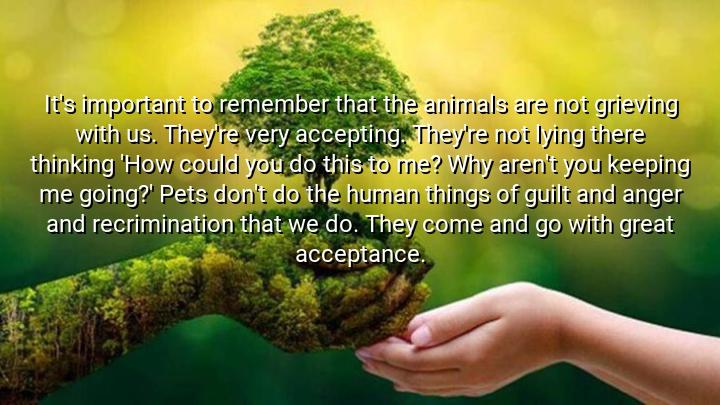




In this quote, Jon Katz reflects on the way animals, particularly pets, handle death and loss in comparison to humans. He emphasizes that animals are not consumed by grief, guilt, or anger when faced with their own mortality or the death of a loved one. Unlike humans, who often experience complex emotions like recrimination or regret during times of loss, animals exhibit a profound sense of acceptance in the face of life's natural cycles, including death.
Katz suggests that pets do not dwell on why something is happening or question the actions of their owners. They don't harbor feelings of betrayal or resentment, which are common in human responses to loss. Instead, pets live in the moment, accepting both their existence and eventual departure with calmness and without judgment. This level of acceptance can be seen as a form of emotional simplicity that contrasts with the often turbulent and self-reflective emotions humans experience during times of hardship.
The quote also highlights the unique bond between humans and their pets, illustrating how animals can serve as a source of emotional comfort and understanding, free from the weight of human guilt or anger. This acceptance may even offer humans a model for coping with grief, suggesting that there is value in learning to embrace life and loss without the burden of negative emotions.
Ultimately, Katz’s quote emphasizes the wisdom and peace that animals offer in the face of difficult situations. Through their acceptance, pets provide a calming presence and a reminder to humans about the importance of living in the present and accepting the natural course of life, without the complications of human emotional baggage.

[[N]•Cao
Reading this, I’m struck by the idea that pets might embody a kind of emotional freedom that humans often lack. Does their acceptance suggest a wisdom about life and death we could aspire to? At the same time, does this perspective risk oversimplifying the bond between humans and animals, which can be deeply emotional? I’d like to explore how recognizing these differences affects how we care for and honor our pets.
MLNguyen Minh Lap
This perspective challenges the common human tendency to anthropomorphize pets and assume they share our emotional experiences. Could this projection sometimes hinder the grieving process or cause unnecessary guilt for pet owners? How can understanding animals’ different emotional frameworks help us form healthier relationships with them? It’s an important reminder to respect the unique nature of animal consciousness.
MHNguyen Thi Minh Huyen
The contrast between human and animal responses to loss brings up questions about emotional complexity. Are animals truly free of feelings like guilt and anger, or do they simply express them differently? How do cultural beliefs about animals influence how we interpret their behaviors? I’m curious whether pets’ acceptance is a natural trait or a learned adaptation to living with humans.
DTLUONG DUC THUAN
I find this idea about animals’ acceptance of life’s impermanence fascinating. Does this mean that animals live more in the moment, without the burden of guilt or resentment? How might humans learn from this attitude to reduce their own suffering? It also makes me question whether we sometimes unfairly burden pets with expectations about loyalty and gratitude that are actually human constructs.
NYNhi Nguyen Yen
This quote offers a comforting yet sobering perspective on how animals experience life and death compared to humans. It makes me wonder how much of our grief comes from projecting our human emotions onto pets. Could accepting their apparent serenity help people cope better with loss? Also, does this highlight a fundamental difference in consciousness between humans and animals, or is it simply a different way of processing emotions?