

It angers me when sustainability gets used as a buzz word. For 90 percent of the world, sustainability is a matter of survival.
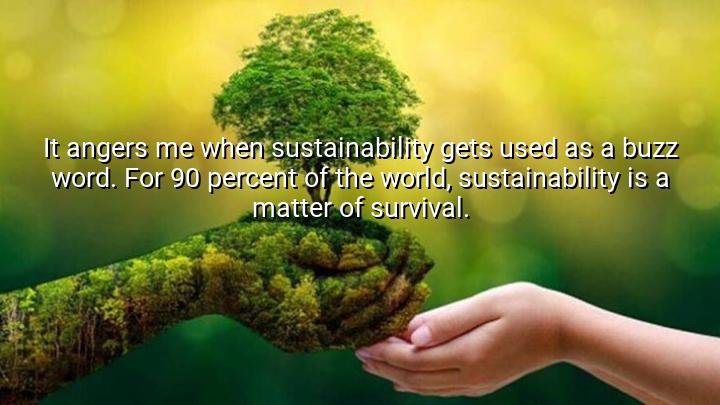




In this quote, Cameron Sinclair expresses his frustration with the way sustainability has become a buzzword, often used superficially without real commitment or understanding. He argues that for the majority of the world, sustainability is not just an abstract concept or a marketing tool, but a matter of survival. Sinclair emphasizes that, for people living in resource-deprived or environmentally challenged areas, sustainability is a fundamental need for long-term survival, not just a trendy or corporate-driven idea.
Sinclair’s statement critiques the commercialization and dilution of the concept of sustainability, particularly when it is used to sell products or ideas without addressing the real issues of resource depletion, environmental degradation, and social inequality. The term is often used in a way that is disconnected from the urgent, life-or-death struggles faced by people in marginalized communities around the world, where sustainability is a critical factor in their ability to access food, water, and shelter.
The origin of this quote likely comes from Sinclair’s work as an architect and humanitarian who has been involved in projects that aim to provide sustainable housing and solutions for communities in crisis. As a co-founder of the design charity Architecture for Humanity, Sinclair has seen firsthand how sustainability can be a matter of survival in impoverished or disaster-stricken areas. His frustration with its commodification stems from his deep commitment to solving real-world problems rather than engaging in empty rhetoric.
Ultimately, Sinclair’s quote serves as a call to action, urging people to reconsider how they use the term sustainability. It is a reminder that, for many around the world, sustainability is not just a buzzword to be used in marketing campaigns or corporate strategies, but an essential and urgent need that directly affects their ability to survive and thrive.

UGUser Google
This quote prompts me to consider how sustainability efforts differ between regions. What are examples of sustainability as survival in practice, and how can they inform global strategies? How can richer nations support these efforts authentically rather than superficially? It underscores the ethical dimension of environmental and social responsibility.
BBi
The anger expressed here seems rooted in frustration over trivialization of a serious issue. How do media and education systems contribute to or counteract this misuse of sustainability? Could storytelling from those directly impacted help shift the narrative from buzzword to life-or-death necessity? It’s a reminder that language shapes priorities.
BBbin ben
Reading this, I’m curious about how sustainability as a buzzword affects public perception and policy. Does it create complacency or skepticism among people who feel the term is overused? How might advocates reframe sustainability to emphasize urgency and justice? This quote highlights the need for clearer communication and real-world impact.
VA05. Nguyen ha van anh
This statement makes me think about the role of privilege in framing sustainability. Are those in wealthier nations disconnected from the harsh realities faced by 90 percent of the world? How can global conversations about sustainability become more inclusive and action-oriented to reflect the survival stakes for most people? It’s a call for humility and deeper engagement.
UGUser Google
I find this perspective compelling because it points out a stark disparity in how sustainability is experienced worldwide. How can policymakers and corporations ensure that sustainability initiatives don’t just become marketing jargon but actually serve vulnerable populations? This quote invites reflection on equity and the real meaning of sustainability beyond trendy concepts.