

In our daily life, we encounter people who are angry, deceitful, intent only on satisfying their own needs. There is so much anger, distrust, greed, and pettiness that we are losing our capacity to work well together.
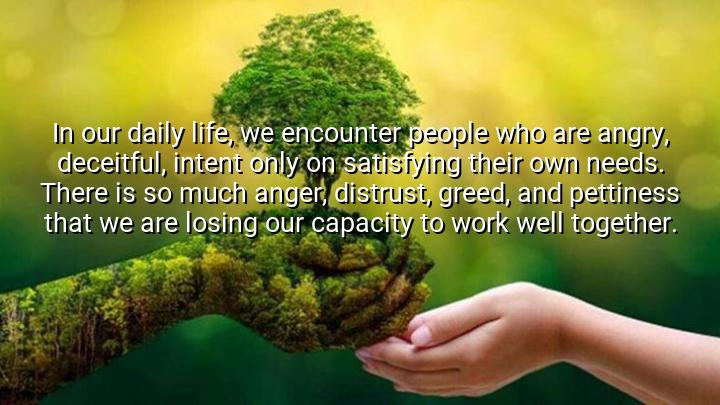




In this quote, Margaret J. Wheatley reflects on the negative emotional forces that hinder collaboration and cooperation in our daily lives. She points out the prevalence of anger, deceit, greed, and pettiness among individuals, all of which contribute to a culture of distrust and self-interest. Wheatley suggests that when people are focused only on satisfying their own needs—often at the expense of others—it becomes increasingly difficult to foster an environment where people can work well together. These negative emotions create barriers to effective collaboration, making it harder to achieve common goals.
Wheatley’s statement highlights the detrimental effects of self-centeredness on both personal relationships and broader societal dynamics. When individuals are consumed by anger or driven by greed, they prioritize their own desires over collective success. This disrupts trust and leads to a breakdown in communication and shared purpose. Wheatley emphasizes the importance of cultivating a sense of mutual respect and collaboration, as without it, we risk losing our ability to work harmoniously in both personal and professional settings.
The origin of this quote lies in Wheatley’s broader work on leadership and organizational change. As a writer and management consultant, she often addressed the challenges faced by organizations in creating environments of trust and cooperation. Wheatley was particularly concerned with the effects of toxic behaviors—such as anger and greed—on organizational culture, and her teachings encouraged leaders to foster environments that promoted empathy, respect, and open communication.
Ultimately, Wheatley’s quote serves as a reminder of the destructive impact that negative emotions can have on relationships and teamwork. By recognizing and addressing emotions like anger, distrust, and pettiness, we can begin to shift towards more collaborative, respectful interactions that enable us to work together effectively.

PQLe Ngoc Phuong Quyen
This reflection points to a crucial issue in both personal and professional realms. I’m curious about what practical steps can be taken to counteract these divisive forces. Could conflict resolution training, open communication, or restorative justice practices help? And how can we encourage people to move beyond self-interest towards common goals without ignoring legitimate needs and concerns?
TTHong Ha Truong thi
The quote’s mention of greed and pettiness makes me think about the impact of individualism versus collectivism. Are societies that emphasize individual success more prone to these destructive behaviors? How might shifting values towards community and mutual support help restore cooperation? I also wonder about the psychological effects of constant exposure to negativity and how that shapes our interactions.
TAThu Than Anh
This statement prompts me to question whether we are truly losing our ability to work together or if it’s just more visible now due to social media and other communication tools. Is the problem more about perception or reality? How do we differentiate between genuine conflict and necessary debate versus destructive anger and deceit? Understanding this might help in addressing the root causes more effectively.
PAngo phuong anh
I can relate to this observation, as it highlights a growing frustration with the breakdown of cooperation. Does this pervasive anger and greed stem from larger systemic problems, or is it more about individual attitudes? How can communities and organizations cultivate empathy and shared purpose to overcome the barriers created by distrust and pettiness? It seems like a big but necessary challenge.
NNPham Le Nhu Ngoc
This quote feels very relevant to today’s social and work environments, where mistrust and selfishness seem widespread. It makes me wonder how much this negativity actually hinders collaboration and progress. Are there practical ways to rebuild trust and encourage teamwork despite these challenges? Also, what role do leadership and culture play in either exacerbating or alleviating these issues?