

In a decaying society, art, if it is truthful, must also reflect decay. And unless it wants to break faith with its social function, art must show the world as changeable. And help to change it.
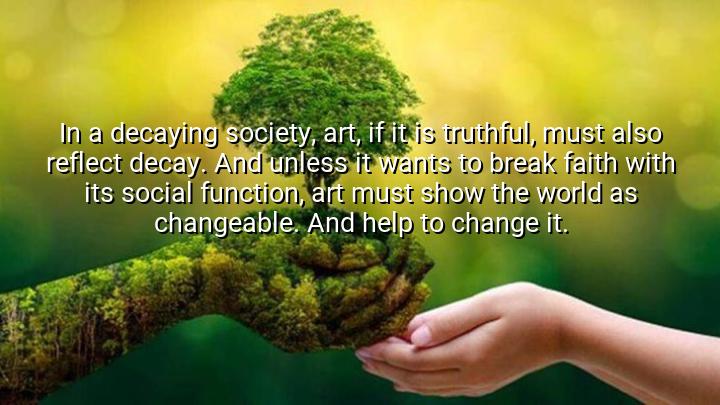




The quote "In a decaying society, art, if it is truthful, must also reflect decay. And unless it wants to break faith with its social function, art must show the world as changeable. And help to change it" by Ernst Fischer emphasizes the role of art as a mirror to society’s struggles and imperfections. Fischer argues that in times of social or moral decline, art must not shy away from depicting the harsh realities, including the decay of values, institutions, or relationships. To be truthful, art must confront the flaws of its era rather than idealize or escape from them.
Fischer also highlights the social function of art, which he believes is to engage with and reflect upon society’s conditions. If art fails to acknowledge the decay present in society, it risks losing its connection to the world it seeks to represent. Art is not just a passive reflection; it has an active role in showing that the world is changeable and can be improved. This transformation is part of its purpose: art must inspire change and promote a vision of a better future by addressing societal flaws and encouraging critical thought.
The origin of this quote is rooted in Fischer’s belief in the social responsibility of artists. As a writer and philosopher, he saw art as a tool for social change, especially in times of crisis. Fischer was deeply concerned with the moral and political state of society, and he believed that art should reflect and address these issues. By showing the world’s changeability, art can become a catalyst for transformation.
By stating that art must show the world as changeable and help to change it, Fischer underscores the dynamic and active role of the artist. Rather than being a passive observer, the artist must engage with the world’s problems and use art as a means of challenging and improving society. In this way, art becomes a powerful agent for social change, offering both critique and hope for a better future.

TDAnh Tuyet Dao
This quote makes me think of all the dystopian films, gritty street murals, and raw poetry I’ve seen that seem to echo this exact sentiment. But it also makes me wonder—how do we avoid glorifying decay? Sometimes dark, decaying imagery becomes trendy or aestheticized. Does that dilute its critical power? I’m concerned that the market can co-opt even the most socially aware art, turning protest into product. How do artists resist that?
TMPhan Nguyen Tra My
I love the idea of art helping to change the world, but I also wonder—how much change can it realistically bring about? In a society where people are desensitized or overwhelmed by decay, does art still have the power to stir action? Or has its function shifted more toward reflection than transformation? Fischer’s quote is idealistic, and I admire that, but I question how effective art can be in practice today.
DHLe Duc Hieu
I'm curious how this quote applies across cultures and political systems. In places where censorship is strong, can truthful art that reflects decay even exist? And if it does, is it always subversive by nature? Fischer's view assumes a kind of freedom or risk-taking that not all artists are able—or willing—to take. Does staying silent in such environments count as a form of betrayal, or a survival tactic?
NKCao Nguyet ky
The part that really grabs me is the idea that the world must be shown as changeable. That’s such a hopeful yet demanding expectation for art. Does this mean artists are responsible not just for depicting reality, but also for inspiring transformation? That’s a heavy burden. I’d love to hear how artists balance that role—between documenting what’s wrong and imagining what could be. Is every piece of critical or activist art inherently hopeful?
JLjocasta la
Fischer’s statement makes me think about the tension between artistic autonomy and social responsibility. Should artists feel obligated to address decay, especially in a time of environmental collapse, political unrest, or economic disparity? What if their personal truth is internal or emotional rather than social? I agree that art can be a powerful tool for change, but can it also just be a refuge or meditation without 'breaking faith' with its role?