

I don't want life to imitate art. I want life to be art.
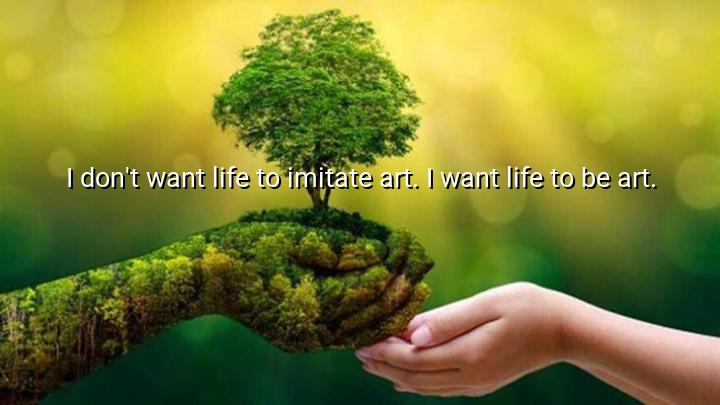




The quote "I don't want life to imitate art. I want life to be art" by Ernst Fischer conveys a powerful philosophical stance on the relationship between life and artistic expression. Fischer rejects the notion that life should simply replicate or reflect the forms of art. Instead, he envisions a world where life itself is imbued with the creativity, beauty, and meaning found in art. In this view, the boundaries between art and life dissolve, and everyday experiences become opportunities for creative expression.
Fischer’s statement challenges the traditional understanding of art as something separate from daily existence. He argues that rather than merely imitating or recreating life, art should inspire us to live more creatively, turning every aspect of our existence into a form of artistic expression. This perspective encourages individuals to find beauty and meaning in their own actions, choices, and experiences, much like an artist does when creating a work of art.
This idea aligns with Fischer’s broader belief in the transformative power of art and its potential to shape society. He suggests that art should not be confined to galleries or museums but should permeate all aspects of life, elevating ordinary experiences to the level of artistic creation. By advocating for life to be art, Fischer calls for a more conscious, intentional way of living, where every action and decision is infused with creativity and purpose.
Ultimately, Fischer’s quote is a call to reimagine life as an ongoing artistic process, one in which we actively shape our own experiences and express ourselves through the choices we make. It challenges the conventional separation between the world of art and the world of life, inviting individuals to view their lives as works of creative expression.

NLnguyen lieu
I find this quote poetic, but I also feel a twinge of skepticism. Art is often curated and deliberate. If we aim for life to be art, does that mean we start performing rather than living authentically? Could we fall into the trap of staging our lives for aesthetics rather than meaning? There's a danger in turning every moment into a masterpiece—what happens to the messy, imperfect, unedited parts of being human?
TKHo Tran Trung Kien
Is this idea even accessible to everyone? It sounds inspiring, but I think about people who are just trying to survive—pay bills, raise kids, get through the day. For them, can life really be 'art,' or is that a privilege reserved for those with time, means, or freedom? Fischer’s vision seems idealistic, but possibly exclusionary. I'd love to know how this quote could be reframed in the context of struggle or necessity.
KNQuoc Khoa nguyen
I'm curious how this philosophy would translate into real-life decisions. If someone lived by this mindset, would they be more likely to take risks, pursue beauty, or reject convention? Would it make them selfish—living for the sake of expression—or selfless, creating meaning for others? There’s a fine line between living artistically and living irresponsibly. How do you balance authenticity and accountability under such a worldview?
TBKhoi Truong Bao
This quote makes me wonder: does aspiring for life to *be* art place unrealistic expectations on ourselves? I get the romanticism of turning daily existence into something expressive and beautiful, but life also includes pain, banality, and obligations. Is Fischer encouraging idealism that might be emotionally unsustainable, or is he pointing toward a mindful, creative approach to living even amid the mundane? There's tension in that thought, and it’s unsettling in a good way.
TThien_Thanh
Is it really possible for life itself to *be* art, rather than just reflect it? I’m intrigued by what Fischer might mean here. Art often has boundaries—mediums, frames, audiences—while life is raw, unpredictable, and messy. Could Fischer be suggesting that we live with intentionality, creativity, and expressive freedom? Or is it more about breaking the separation between the aesthetic and the everyday? I’d love to hear interpretations of this idea.