

I think that art has the ability to capture people's imaginations and make them think that more is possible.
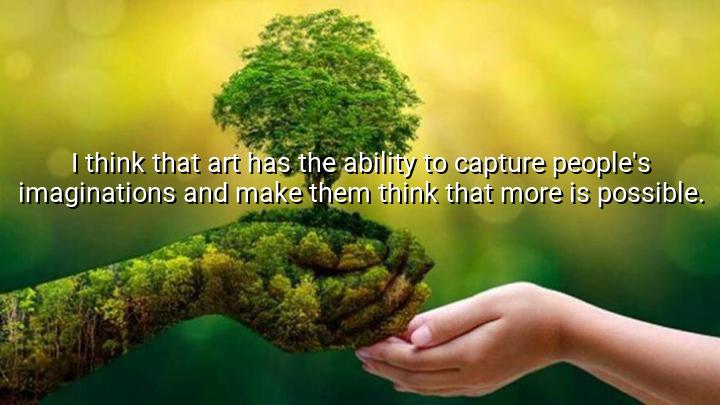




In this quote, Shepard Fairey reflects on the power of art to inspire and expand the imagination of its audience. He suggests that art has the unique ability to not only capture people's attention but also to encourage them to believe that more is possible—that there are possibilities beyond their current limitations or understanding. Art, in Fairey’s view, is not just about visual enjoyment, but about sparking ideas and challenging the status quo, pushing people to imagine new ways of thinking and being.
Fairey’s statement underscores the transformative nature of art. He sees art as a tool for change, capable of shifting perspectives and opening up new possibilities. By presenting something different, something innovative, art can inspire individuals to envision a world that is more dynamic, inclusive, or forward-thinking. It plays a critical role in cultural evolution by inspiring people to question existing norms and consider alternatives that might not have seemed possible before.
The phrase "make them think that more is possible" highlights art’s capacity to empower people. It instills a sense of hope, possibility, and creativity, encouraging individuals to reach beyond their immediate environment and consider what could be achieved. This type of inspiration is often what drives social movements, innovation, and personal growth, as art allows people to envision futures that might seem out of reach but are within the realm of possibility.
Ultimately, Fairey’s quote speaks to the motivational role of art. It is not just a passive form of expression but a force that can propel individuals to think differently and strive for more. Art is a reminder that the world is full of potential, and through creativity and imagination, people can tap into new possibilities, transforming both themselves and their surroundings.

LPVy Lop Pho
Do you think all art has the potential to do what Shepard Fairey describes, or only certain kinds? For instance, is pop art just as capable of sparking imagination and change as more overtly political or conceptual work? I sometimes feel overwhelmed by the volume of art out there—it makes me wonder what criteria we should use to determine what’s actually impactful and what’s just aesthetically pleasing noise.
LAGiau ten le, A.R.M.Y
I'm fascinated by the idea that imagination is the gateway to possibility. But how does this actually translate to real-world action? Can the emotions or ideas sparked by a painting, film, or song genuinely lead to societal or personal change? I’d like to see examples where art did more than inspire—it mobilized people. Are there historical moments where creative work directly shaped tangible progress?
TGAnh Quyen xinh gai so 1 the gioi
I agree with the spirit of the quote, but I also worry that art can sometimes manipulate rather than inspire. What if the imagination it stirs leads people in harmful directions or perpetuates illusions? I’m not saying art should be censored, but should artists be more conscious of the impact their work can have on vulnerable or impressionable audiences? Where’s the ethical line between inspiration and influence?
HHHan Hoai
This makes me wonder—how much of that imaginative power comes from the art itself versus the mindset of the viewer? Can someone who feels stuck or hopeless still find inspiration through art, or does it require a certain openness or readiness? I guess I'm curious about whether the magic is in the creation or in the reception. What role does context play in how art influences our thoughts and aspirations?
KTKien Trung
Does art truly have the power to expand our sense of what's possible, or are we just projecting our hopes onto it? I'm torn. Sometimes I feel like art just reflects the world back to us rather than opening new doors. But then, a single piece can stop me in my tracks and make me reconsider everything. I'd love to hear how others have personally experienced this kind of transformative moment through art.