

The way I make art - the way a lot of people make art - is as an extension of language and communication, where references are incredibly important.
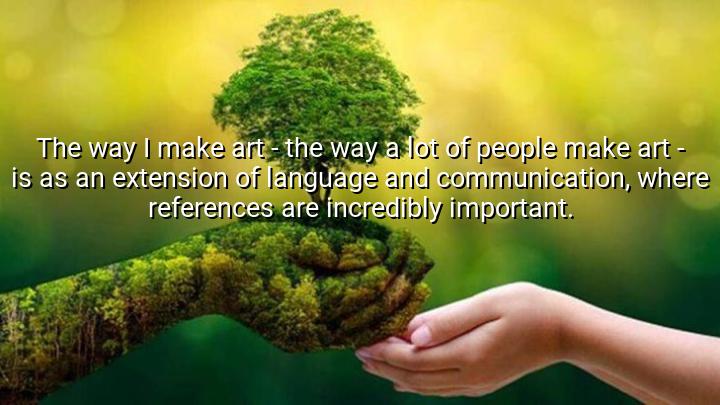




The quote by Shepard Fairey — “The way I make art – the way a lot of people make art – is as an extension of language and communication, where references are incredibly important.” — emphasizes the idea that art is not merely a form of self-expression but a powerful tool for communication. For Fairey, visual art functions much like language, capable of conveying complex ideas, messages, and cultural references that provoke thought and inspire dialogue. He highlights how references—to history, politics, pop culture, or past artworks—add depth and meaning to the images he creates.
The origin of this quote is rooted in Fairey’s role as a prominent contemporary street artist and graphic designer, best known for works like the Obey Giant campaign and the iconic Hope poster for Barack Obama’s 2008 presidential campaign. His art often blends text, imagery, and symbolism to make pointed social or political commentary, making it immediately recognizable and deeply layered. Fairey frequently uses visual references to connect his audience with broader cultural narratives, encouraging viewers to engage with the work beyond surface aesthetics.
By describing art as an extension of language, Fairey underscores the intentionality behind visual creation. Just as words are chosen carefully to express a thought, visual elements in art are selected or arranged to communicate something specific. His emphasis on references shows that good art doesn’t exist in a vacuum; it builds upon collective memory, shared symbols, and historical context, creating a richer conversation between the artist and the audience.
Ultimately, Fairey’s quote invites us to view art not only as a personal or decorative pursuit, but as an active form of cultural dialogue. In his view, artists are like visual linguists, using color, form, and iconography to engage with the world. This approach reinforces the idea that meaningful art is both intentional and context-aware, and that its greatest strength lies in its ability to speak to people—across time, background, and ideology.

AAdministratorAdministrator
Welcome, honored guests. Please leave a comment, we will respond soon