

I think everybody should have the same anger towards the injustice that's happening and the hatred that's happening, and just fight it with love and compassion.
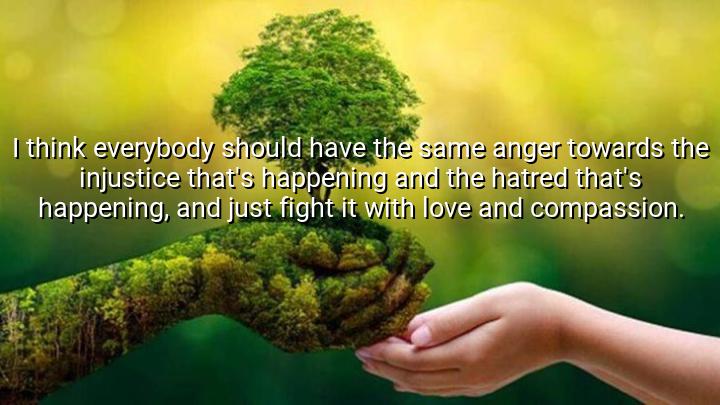




In this quote, Ellen DeGeneres emphasizes the importance of having a shared sense of anger towards injustice and hatred in the world. She advocates for a collective emotional response to these issues, suggesting that instead of perpetuating negativity, people should counteract them with love and compassion. DeGeneres promotes the idea that positive emotions like love and compassion can be powerful tools in fighting societal problems, encouraging others to respond to hate and wrongdoing with empathy and understanding rather than retaliation.
DeGeneres’ message highlights the idea that anger at injustice is a valid and necessary emotion, but how one chooses to express that anger is crucial. Instead of letting anger fester into resentment or hatred, she proposes that people use it as motivation for change through positive and constructive means. By fighting with love and compassion, individuals can create a more peaceful and understanding world, turning their frustration into a force for good.
The origin of this quote is rooted in DeGeneres’ long-standing advocacy for kindness and acceptance, especially in her role as a television host and comedian. She has frequently used her platform to speak out against social issues like discrimination, inequality, and hatred, encouraging people to approach these challenges with a mindset of empathy and respect. Her personal commitment to love and compassion is reflected in both her public persona and her philanthropic efforts.
Ultimately, DeGeneres’ quote serves as a reminder that while anger at injustice is natural and necessary, the way we choose to act on it can have a profound impact. By responding with love and compassion, we not only challenge hatred and inequality, but we also set an example of how to build a more harmonious and empathetic society.

THHuynh Bui Thanh Hien
This quote made me pause—can anger and compassion really coexist effectively in activism? I usually associate anger with destruction and compassion with healing, so blending them feels a bit contradictory. But maybe that’s the point: to hold both truths at once. Still, I wonder, is there a risk that encouraging love over direct confrontation might dilute the urgency of the fight? How do you keep both forces in balance?
NDQuan Nguyen dinh
The idea of channeling anger into compassion is beautiful, but isn’t it also incredibly hard? Anger can feel consuming and righteous, especially when you witness cruelty or inequality. What are the emotional tools or practices that allow someone to stay centered in love without becoming numb or disengaged? I’d really appreciate insights from spiritual or psychological perspectives on how to turn reactive anger into purposeful, loving action.
UGUser Google
Ellen’s quote makes me think about how emotional responses to injustice vary so much. Is anger always necessary, or can peaceful conviction be just as powerful? I worry that demanding uniform outrage might alienate people who show their resistance in quieter ways. Can we create space for both fiery activism and gentle persistence, as long as the goal is the same? Maybe it’s more about shared values than shared emotional intensity.
VAPham Viet Anh
I admire the idealism in this statement, but is it realistic to expect everyone to feel the same anger? People come from such different backgrounds and experiences—some may be desensitized or unaware of the injustice around them. How do we inspire empathy and urgency in those who haven’t been directly affected? And does love and compassion alone have the power to dismantle systems that thrive on exploitation and division?
DPDung Pham
This quote resonates deeply, but I can’t help wondering—how do you balance justified anger with love and compassion in practice? It’s easy to say we should fight hate with kindness, but what does that really look like when people are being actively harmed or oppressed? Is there a line where compassion becomes passivity? I’d love to hear examples of movements or individuals who’ve truly embodied this principle without compromising justice.