

I don't usually lose my temper, but if I get angry, it's true - I'm scary.
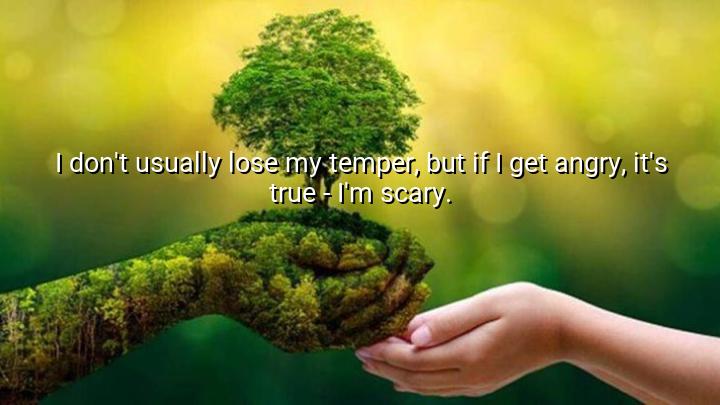




In this quote, Eva Mendes acknowledges that she doesn’t often lose her temper, but when she does, it can result in her becoming very angry and intense. She admits that her anger, while rare, can be quite powerful and scary, suggesting that she may not exhibit outward signs of anger frequently, but when she does, it’s an overwhelming experience for those around her. The quote reveals her self-awareness about how she handles emotions and the impact her anger can have.
Mendes’ statement also speaks to the intensity of human emotions and how even someone who is generally composed can have moments of heightened emotion. By saying she’s "scary" when angry, she adds a layer of vulnerability to her self-awareness, acknowledging that her emotions can sometimes surprise others in their intensity. This highlights the unpredictability of emotional responses, even for people who typically maintain control.
The phrase "I'm scary" emphasizes the idea that anger, when it does arise, can be a force of power. Mendes is reflecting on how emotions like anger, if not tempered, can shift someone’s demeanor and personality, making them appear far different from their usual self. It is a reminder that emotions have the power to change how we are perceived, especially when they are intense or unrestrained.
Ultimately, Mendes' quote highlights the human complexity of emotions, showing that even those who generally maintain their composure can have moments when their anger emerges in surprising and formidable ways. It encourages a deeper understanding of emotional balance and the effects it can have on interactions with others.

MLMai Loc
This quote makes me think about the fine line between controlled anger and losing control. Is being ‘scary’ when angry necessarily negative, or can it sometimes serve as a protective mechanism? How do we distinguish between healthy expressions of anger and harmful ones? And does the rarity of anger make it more credible or impactful when it finally surfaces? It seems to suggest that anger, though infrequent, commands attention and respect.
NNNgoc Nhu
Reading this, I wonder about the psychological effects of having a scary temper. Does it cause stress or guilt in the person who experiences it, especially if it’s rare but intense? How might this affect their self-image or relationships? Could such an admission be a form of self-awareness or even a preemptive warning? How do people typically reconcile their calm identity with moments of scary anger?
AQPhung Kim Anh Quan
I’m intrigued by how this quote acknowledges a dual nature — calm most of the time, but fierce under certain conditions. Does this suggest that people respect or fear the ‘angry side’ more? How might this influence someone's willingness to confront or challenge the person? Could this be a way to assert boundaries firmly? It makes me think about how anger can be a powerful, if sometimes dangerous, tool in communication.
HTHoaii Thuu
This statement sparks curiosity about the social perception of anger, especially in women. Do you think society tends to label angry women as ‘scary’ more often than men? How does that shape how women express their anger? Also, is there a cultural difference in how temper is viewed? I wonder if the quote is embracing that fearsome reputation or warning others to be cautious, or maybe both.
YNNguyen Thi Yen Nhi
I find this quote relatable but also a bit concerning. While it’s normal to get angry sometimes, being ‘scary’ when angry might imply a loss of control that could affect relationships. Is there a way to express anger constructively without intimidating others? Does acknowledging one’s own potential for a fierce temper help in managing it better? How do people close to someone like this usually respond when that side emerges?