

I don't think anybody should ever touch anybody in anger, ever.
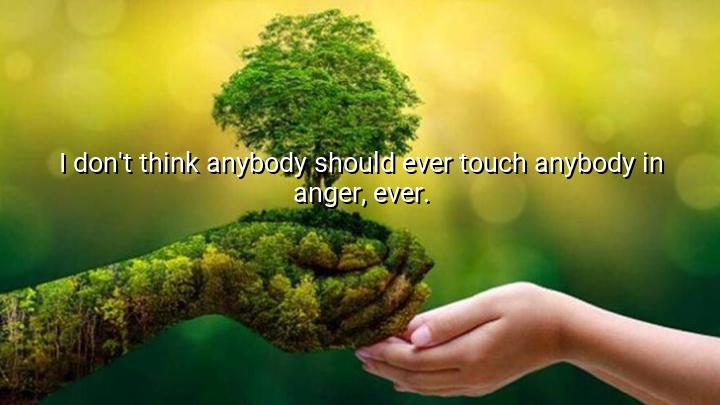




In this quote, Tommy Lee expresses a firm stance against the act of using anger as a justification for physical aggression. By saying "nobody should ever touch anybody in anger," he highlights the destructive nature of reacting to frustration or rage through violence. Lee is advocating for emotional restraint, underscoring that physical contact motivated by anger can escalate conflicts and cause irreparable harm, both physically and emotionally.
Lee’s statement also reflects a broader message about personal responsibility and the importance of finding healthier ways to manage intense emotions. Instead of resorting to violence, he encourages individuals to seek other forms of expression or conflict resolution, promoting the idea that acting out of anger is never acceptable, regardless of the situation. This idea suggests a deeper commitment to emotional self-control and the belief that respect for others should always prevail.
The quote also serves as a call to prevent harm in relationships and interactions. Lee's perspective implies that true strength lies not in acting on impulsive feelings of rage, but in exercising patience and understanding. His words aim to discourage physical aggression, which often exacerbates problems, replacing it with a more thoughtful and peaceful approach.
Ultimately, Tommy Lee’s message is clear: anger should never be an excuse for hurting others. His call for non-violence is rooted in a desire for healthier, more respectful ways to handle emotional turmoil, emphasizing the need for greater emotional intelligence in personal interactions.

TTAnh Trieu Thi
This makes me think about how anger is handled in intimate relationships. Even if someone agrees with this principle, what happens if their partner doesn’t? How can we support people who are trying to live by nonviolence in emotionally volatile or unsafe environments? I’d love to hear more about how we can collectively enforce this boundary through community or legal support systems.
HNLan Huong Nguyen
I love how straightforward this quote is—no justification, no gray area. But I'm curious: do you think society takes emotional abuse as seriously as physical anger? Sometimes people justify non-physical harm by saying 'at least I didn’t hit them,' but words and manipulation can be just as damaging. Shouldn’t we also be addressing those invisible touches of anger too?
QNQuynh Nhu
I admire the principle, and it makes me think about how often physical expressions of anger are normalized in media and even relationships. Should this kind of moral clarity be taught more explicitly in schools or parenting approaches? And what role should accountability play in cases where someone violates this boundary, especially if they’ve grown up in violent environments?
TNTrang Nguyenn
This statement feels powerful and absolute. But do you think there’s ever a context—like self-defense—where physical response in anger could be justified? I’m not advocating violence, but I’m curious where we draw the line between expressing anger and defending oneself. How do we differentiate between reactive harm and protective action when emotions are intense?
GDGold D.dragon
I agree with the sentiment completely, but I wonder—how do we teach people to stop themselves in the heat of the moment? It's one thing to believe no one should act out physically in anger, but quite another to interrupt that response when you're triggered. What kinds of tools or interventions actually work in real-life situations, especially when emotions run high or past trauma is involved?