

I choose a block of marble and chop off whatever I don't need.
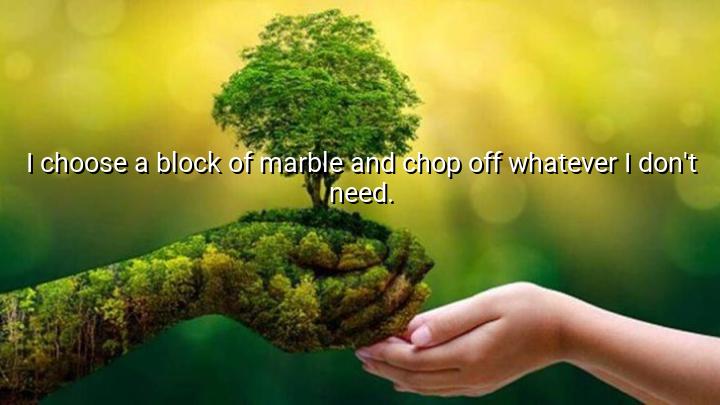




The quote "I choose a block of marble and chop off whatever I don't need" by Auguste Rodin reflects the artist’s approach to the creative process, particularly in sculpture. Rodin, a renowned French sculptor, is known for his work in marble, especially pieces like "The Thinker" and "The Kiss." This quote suggests that, for Rodin, art is about discovering and unveiling what already exists within the material, rather than adding to it. He likens the process of sculpting to removing the unnecessary, allowing the true form to emerge from the block of marble.
By saying "chop off whatever I don't need," Rodin emphasizes the idea that the artist's role is not to impose something new upon the material but to reveal the potential within it. The marble is seen as a raw, unshaped form, and the sculptor’s task is to subtract the parts that are not part of the final vision. This process of subtraction mirrors a philosophical view of art, where the artist works with the material’s natural qualities to bring out its inherent beauty.
Rodin’s approach also speaks to the simplicity and focus required in artistic creation. The quote implies that creating art is not about overwhelming the viewer with unnecessary details or additions, but about distilling the work down to its essential and most meaningful components. The artist must have a clear vision of what to keep and what to discard, honing the work until only the most important elements remain.
Ultimately, this quote illustrates Rodin’s belief that art is about discovery and refinement. The artist, like a sculptor working with a block of marble, removes excess and focuses on revealing the truth within the material. In this way, art becomes an act of clarity and precision, bringing out the beauty that is already there rather than creating something entirely new.

Ddoikiemminh
This idea of ‘chopping off whatever I don’t need’ is such a great metaphor for not just sculpture, but also how we approach any type of work or creation. But can this process of removal go too far? Sometimes we hear that creativity involves adding layers and experimenting, not just cutting away. Is there a danger in trying to make things too minimal, or can this philosophy truly lead to the purest expression of an idea?
PANguyen Phuoc Phuong Anh
Rodin’s quote makes me think of art as a process of refinement rather than creation. It’s fascinating how he sees his sculptures not as something he builds, but as something he reveals. But how do we apply this philosophy to our own projects? Can we remove too much and end up with something hollow, or is the act of simplification always beneficial in the end? How do we ensure that we’re leaving the essential elements intact?
MPQuynh Mai Pham
Rodin’s approach to sculpture as a process of elimination rather than addition seems so practical, yet profound. I wonder, is this how all great creators work? Is the secret to good art less about invention and more about discernment—knowing what to leave out? But how does this process apply to things that don’t have a clear shape or structure, like music or writing? Can the same principle of elimination apply there too?
UGUser Google
This quote by Rodin really resonates with the idea of ‘less is more’. It seems like he’s saying that creativity isn’t about adding more, but about recognizing what’s unnecessary and letting it go. But what about when we’re creating something new in life? How do we know when we’ve pared things down enough, and when should we keep adding layers instead of stripping them away? Is there a line between minimalism and incompleteness?
HTHong Tham
I really like how Rodin simplifies the creative process by focusing on removing what’s not needed, almost like discovering something that was already there. But how do we know what to remove? Is there a point in the artistic or creative process where we risk stripping away too much and losing the essence of what we’re creating? How do we find balance in the process of elimination?