

I always tell people, anger is like liquid. It's fluid, it's like water. You put it in a container and it takes the shape of that container. So many people you see in prison, unleashing war on their people, they are angry, and they take their anger and put it into a violent container.
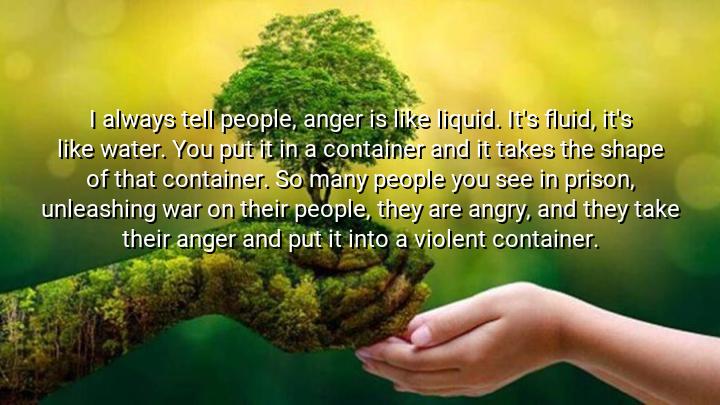




Leymah Gbowee’s quote uses the metaphor of anger as a liquid to explain how emotions can be shaped by the circumstances in which they are expressed. She compares anger to water, which is fluid and adaptable, taking on the form of whatever "container" it is placed in. This suggests that anger is not inherently destructive, but rather that its expression is determined by the environment and situation surrounding it.
Gbowee highlights how individuals can choose how they channel their anger, whether in constructive or destructive ways. In the case of people in prison or those involved in violence, they often allow their anger to take the shape of a violent container, directing their emotions into harmful actions. This speaks to how circumstances, environment, and personal choices influence the outcome of anger—whether it leads to harm or healing.
The quote also suggests that anger, if left unchecked, can lead to catastrophic consequences. When anger is confined to a violent outlet, like the acts of war or prison, it has a destructive impact on both the individual and those around them. By framing anger as something that can be controlled, Gbowee underscores the power individuals have in shaping their emotional responses and choosing healthier ways to cope with their emotions.
Ultimately, Gbowee’s quote calls for reflection on how we handle our emotions. By understanding that anger can take different forms depending on where it is directed, we are reminded of the importance of self-awareness and the need to choose positive channels for our emotions. This idea resonates deeply with her broader work in advocating for peace and reconciliation, where anger is recognized as a powerful force that, when redirected, can contribute to social change rather than destruction.

DDarkUser25
I find the fluidity metaphor powerful because it suggests potential for change. If anger takes the shape of its container, can changing one’s environment or mindset help reshape destructive anger into positive energy? It makes me hopeful about interventions that focus on emotional education and conflict resolution, especially in communities affected by violence.
QTPham Quynh Tram
Reading this makes me think about individual versus systemic factors in anger expression. Are people who commit violent acts victims of their circumstances, or do they bear full responsibility for how they ‘contain’ their anger? It seems like a balance must be struck between understanding root causes and holding individuals accountable, especially in the context of justice.
QHle quang hao
This quote highlights a tragic cycle where anger, when confined to violent environments, fuels more violence. It raises questions about responsibility: To what extent should society address the conditions that create these ‘containers’? Is punishment enough, or should there be a greater focus on prevention and rehabilitation to reshape how anger is expressed?
GDGold D.dragon
I appreciate the metaphor here because it emphasizes the flexibility of anger—it's not inherently violent but shaped by circumstances. This makes me question how society can create healthier ‘containers’ for anger to be expressed safely. What role do education, community support, or therapy play in helping people channel anger without harming themselves or others?
LTlien ta
This analogy of anger as a fluid that adapts to its container is really thought-provoking. It makes me wonder how much of our environment shapes the way we express anger. If people are placed in violent or oppressive contexts, is it inevitable that their anger turns destructive? Could changing the ‘containers’ or environments help redirect anger into more positive or constructive outlets?