

He who would do good to another must do it in Minute Particulars: general Good is the plea of the scoundrel, hypocrite, and flatterer, for Art and Science cannot exist but in minutely organized Particulars.
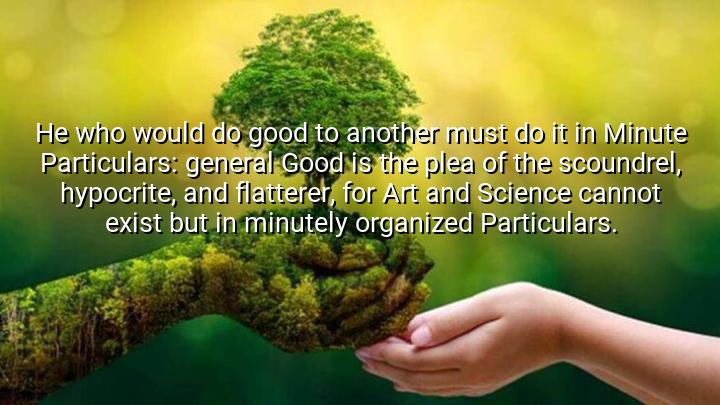




In this quote, William Blake emphasizes that true goodness or moral action lies in paying attention to the minute particulars—the small, detailed actions and decisions that make a real difference in the lives of others. He criticizes the idea of general good, suggesting that it is often used as an excuse by those with less noble intentions, such as scoundrels, hypocrites, and flatterers, who hide behind vague, idealized notions of goodness without taking meaningful action. Blake argues that both art and science depend on careful attention to detail, underscoring that real progress and genuine good come from meticulous effort and organization.
The origin of the quote comes from Blake’s broader philosophical and artistic views, where he often critiqued societal norms and the superficiality of religious and political institutions. As a poet, painter, and visionary, Blake was deeply concerned with the tension between idealism and practicality. He believed that real change and true artistic expression could not be achieved through grand, abstract concepts but only through a deep, focused engagement with the individual and specific elements of life. This is reflected in his belief that every action and every creation must be built on specific, intentional efforts, rather than generalized goals.
Blake’s statement also underscores the importance of detail in creativity and human effort. Whether in art or in life, he suggests that superficial gestures and vague ideals are not enough to bring about true change or improvement. Art and science, in particular, require precision and attention to detail to be truly impactful. By focusing on the minute particulars, one can build something meaningful and lasting, whether in the pursuit of knowledge or in helping others.
Ultimately, this quote is a call to action for a more intentional and thoughtful approach to life, where individuals focus on the small but significant actions that create real change. Blake’s perspective challenges the tendency to seek abstract solutions or idealized visions of goodness and encourages a deeper commitment to the practical and specific efforts that lead to lasting progress in both personal relationships and societal change.

GBNguyen Gia Binh
This quote raises a difficult question for me: how do we ensure our good intentions don’t become self-righteous detachment? Is focusing on individual acts of kindness more ethically sound than advocating for broad reform? Or is there a danger in becoming so focused on small details that we miss the structural causes of suffering? Blake’s words are powerful, but they leave me wondering about the balance between detail and vision.
GDGold D.dragon
I love the tie Blake makes between art, science, and the particular. As someone working in a creative field, I often feel the pressure to make broad, sweeping statements. But this quote reminds me that depth and precision matter more than generalities. Do you think modern education encourages this kind of detailed thinking, or is it too focused on surface-level general knowledge?
BTbich thuong
This quote seems especially relevant to philanthropy and social work. Large foundations often focus on broad impact metrics, but does that mean they're missing the real work, which Blake says lives in particulars? Are we too obsessed with scale and efficiency in modern charitable work? Maybe small, deeply personal actions are actually more transformative—though they don’t make headlines or satisfy data-driven funding models.
UGUser Google
I’m struck by the harshness of calling general good 'the plea of the scoundrel.' Is Blake saying that grand ideals are inherently dishonest? Or is he critiquing the way people use noble causes as a cover for selfish agendas? It raises a hard question: how often do we deceive ourselves by thinking we’re helping, when really we’re avoiding the discomfort of specific, personal effort?
MAminh doan mai anh
Blake’s emphasis on the 'minute particulars' fascinates me. In a world that often pushes us to think big—global change, mass movements—he's suggesting that real impact happens at the smallest, most detailed level. Is that still true today, or does modern complexity require broader strategies? How do we balance detailed attention with the scale of issues we face, like climate change or systemic inequality?