

Can I see another's woe, and not be in sorrow too? Can I see another's grief, and not seek for kind relief?
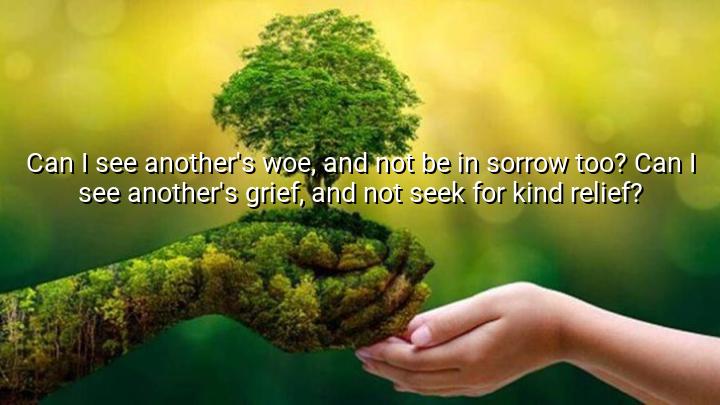




The quote, "Can I see another's woe, and not be in sorrow too? Can I see another's grief, and not seek for kind relief?," reflects William Blake’s deep empathy and moral concern for human suffering. By emphasizing "another’s woe" and "grief," Blake highlights the universal emotional response to the pain of others and the natural human desire to alleviate suffering. The quote conveys the idea that true humanity involves sharing in the sorrow of others and actively seeking to help.
The origin of the quote comes from Blake’s 1789 collection Songs of Innocence and of Experience, where he often explored themes of compassion, morality, and the human condition. In this context, the lines reflect his belief that empathy is a defining feature of a just and moral person, and that witnessing suffering obliges one to respond with kindness and action.
This statement also touches on the theme of interconnectedness and social responsibility. Blake’s reflection illustrates that humans are naturally linked by emotion and moral duty, suggesting that ignoring another’s pain is both unnatural and ethically troubling. By framing the sentiment as a question, he encourages readers to reflect on their own responses to suffering and to consider the importance of compassion in daily life.
Ultimately, the quote demonstrates how empathy and moral action are central to Blake’s philosophy. Through these lines, he underscores that recognizing and responding to the pain of others is not only a moral imperative but also a reflection of our shared humanity, inspiring readers to act with kindness, awareness, and care.
If you want, I can also create a short, poignant version suitable for a social media post highlighting William Blake’s reflections on empathy and human compassion.

AAdministratorAdministrator
Welcome, honored guests. Please leave a comment, we will respond soon