

Those who don't know how to weep with their whole heart, don't know how to laugh either.
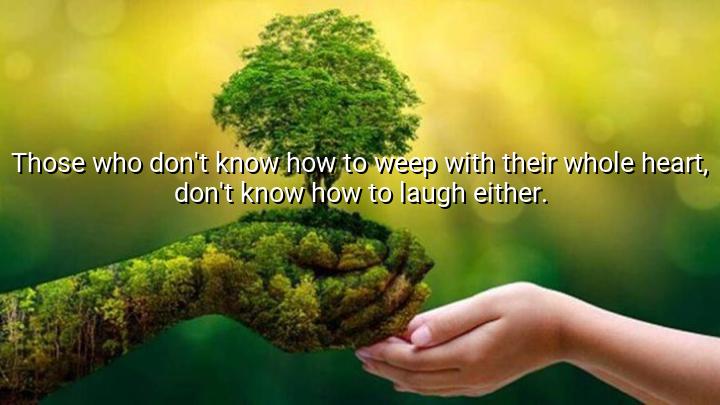




Golda Meir’s quote, "Those who don't know how to weep with their whole heart, don't know how to laugh either," reflects a deep understanding of the connection between human emotions and the full range of experiences we face. The quote suggests that emotional depth requires us to engage fully with both the joys and sorrows of life. To be able to laugh authentically and experience true happiness, one must also have the capacity to weep and feel grief deeply. Meir is emphasizing that a genuine emotional life is one where both extremes—sorrow and joy—are fully felt.
The idea behind this quote is that emotional balance and awareness are essential to truly understanding and appreciating the human experience. By saying that those who don’t know how to weep deeply cannot truly know how to laugh, Meir points out that the ability to experience sorrow with full awareness allows us to better appreciate the lighter, happier moments. Without this emotional contrast, happiness can feel shallow or unearned. It implies that the depth of one emotion enhances the richness of the other, showing how life’s challenges and joys are interconnected.
Meir’s perspective likely comes from her own life, which was marked by significant personal and political challenges. As a key figure in the establishment of the State of Israel, she experienced both immense hardship and moments of triumph, which could have shaped her understanding of the complexities of life. Her quote is a reflection of her belief that true emotional growth comes from embracing all aspects of human experience—the pain and the pleasure, the tears and the laughter.
Ultimately, this quote serves as a philosophical reminder that the richness of life is found not in avoiding difficulty or sadness but in embracing all emotional states. By experiencing and accepting both sorrow and joy, we can live a more whole and authentic life. Meir encourages us to find meaning in both our tears and our laughter, suggesting that one cannot exist fully without the other.

AAdministratorAdministrator
Welcome, honored guests. Please leave a comment, we will respond soon