

Fine art is that in which the hand, the head, and the heart of man go together.
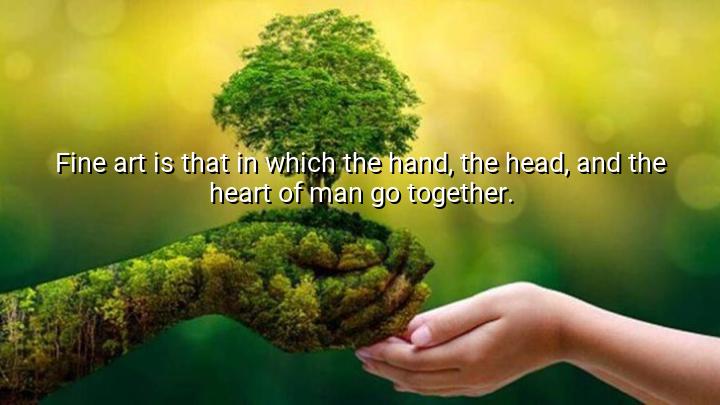




The quote "Fine art is that in which the hand, the head, and the heart of man go together" by John Ruskin emphasizes the holistic nature of art. Ruskin suggests that true art arises when the physical act of creation (hand), intellectual understanding and thought (head), and emotional engagement (heart) are all integrated in the artistic process. For Ruskin, art is not just about technical skill or intellectual knowledge, but also about the deep personal connection the artist feels with their work, resulting in creations that are both intellectually and emotionally resonant.
Ruskin, a prominent British critic and social thinker, believed that art should reflect a balance between craftsmanship, intellectual depth, and emotional expression. In this quote, he stresses that the greatest works of art are those where the artist is fully engaged on all levels—physically creating with their hands, thinking critically with their mind, and pouring genuine feeling from the heart. This harmony between mind, body, and spirit is what elevates a piece of art from mere craftsmanship to something profound and meaningful.
The origin of this quote can be traced to Ruskin’s writings on art and aesthetics, particularly in his book The Elements of Drawing. Ruskin argued that art should not merely be about surface-level beauty or technical skill, but should embody the artist’s full human experience. This idea aligns with his broader critique of industrialization, where he saw the mechanization of art as stripping away the personal and emotional connection that should come from the artist's hand, head, and heart.
For artists, this quote serves as a reminder that art is most powerful when it reflects the complete human experience. It encourages creators to engage fully with their craft, not just as a mechanical process but as a deeply personal and intellectual one, ensuring that their work connects with both the mind and the heart of the viewer. Ruskin’s words advocate for an artistic practice that is thoughtful, emotionally sincere, and skillfully executed.

NNNgoc Nhu
This quote inspires me, especially as someone learning to paint. It reminds me that art isn’t just about technique or ideas—it’s about being emotionally present too. But I also feel a bit intimidated by it. Is it realistic to expect all three elements to be in harmony all the time? What if an artist is still developing emotionally or intellectually? Can the work still be meaningful, or is it considered incomplete?
HDtruong huu dang
I think Ruskin’s view is incredibly humanistic and even idealistic, which is what makes it so compelling. But I also wonder—does this exclude certain types of art that are intentionally cold, minimal, or mechanical? Is it fair to say they aren’t ‘fine art’ because they don’t engage the heart or even the hand in a traditional sense? Could that actually be a limitation in how we define artistic value?
MTminh tri
There’s something timeless in this idea, yet I can’t help but ask—how does this definition apply to digital art or AI-generated work? When the ‘hand’ is a stylus or a code, and the ‘head’ might be an algorithm, where’s the ‘heart’? Can art created with new tools still fulfill Ruskin’s ideal? Or is this view bound to a more traditional understanding of authorship and human-centered creation?
JKjunny kim
I really love how Ruskin frames fine art as a synthesis of physical skill, intellect, and emotional depth. But it also makes me wonder—can a piece be considered fine art if it lacks one of those elements? Like, what about hyper-realistic works with stunning technique but little emotional resonance? Or deeply moving pieces with crude execution? Does all great art really require all three, or is that too rigid a standard?
QNQuan Nguyen
This quote resonates with me deeply. It feels like Ruskin is advocating for balance—not just technical skill or intellectual concept, but emotional sincerity too. I wonder, though, how often we see this kind of unity in contemporary art. Is modern emphasis on conceptual innovation leaving behind the ‘hand’—the craftsmanship? Or maybe the ‘heart’? Do most artists today still strive for this trinity, or is it becoming more fragmented?