

The greatest thing a human soul ever does in this world... to see clearly is poetry, prophecy and religion all in one.
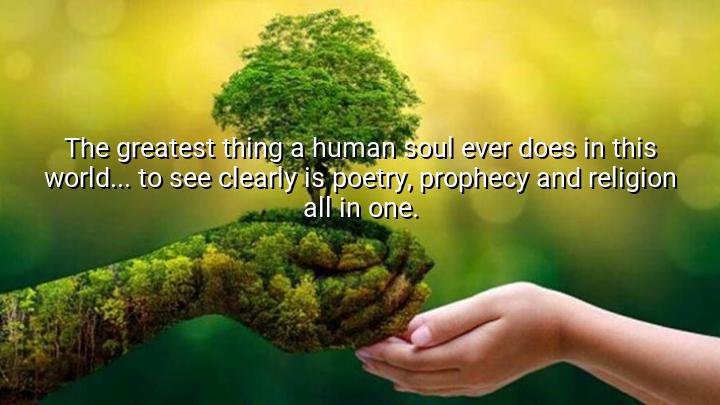




In the quote, "The greatest thing a human soul ever does in this world... to see clearly is poetry, prophecy, and religion all in one," John Ruskin emphasizes the profound importance of clarity and insight in human existence. Ruskin suggests that when a person achieves true understanding or vision—whether it’s about the world around them or their place within it—they are tapping into a deeper spiritual and creative realm. To "see clearly" is not just to perceive things as they are but to understand their deeper, more symbolic meanings, which is akin to the work done in poetry, prophecy, and religion.
The idea of seeing clearly connects these three distinct yet interconnected realms. Poetry allows individuals to capture the profound, often hidden truths of existence through words and imagery. Prophecy, in the religious sense, involves seeing into the future or revealing truths about human nature and the divine. Finally, religion provides a framework for understanding life's ultimate purpose, offering insights into morality, suffering, and transcendence. Ruskin believes that when one can see clearly, these three aspects—artistic, spiritual, and divine—merge into a harmonious and unified vision of life.
Ruskin’s statement also reflects his belief in the interconnectedness of various human pursuits. He suggests that the clearest vision a person can have transcends the boundaries between disciplines, bringing together the aesthetic of poetry, the visionary nature of prophecy, and the moral and spiritual insights of religion. Each of these realms, when understood in their fullest sense, reveals a higher truth about existence, and their convergence is the ultimate achievement for the human soul.
John Ruskin, a 19th-century English art critic, philosopher, and social thinker, was deeply invested in the power of art, nature, and spirituality to inspire human growth. His writings often explored the intersections between beauty, morality, and societal well-being. Through this quote, Ruskin reflects his broader view that true understanding and fulfillment come from seeing the world with both clarity and a sense of wonder, as found in the realms of poetry, prophecy, and religion.

AAdministratorAdministrator
Welcome, honored guests. Please leave a comment, we will respond soon