

The purest and most thoughtful minds are those which love colour the most.
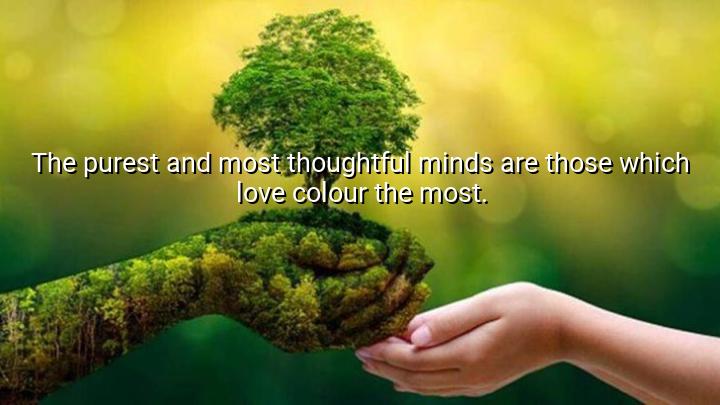




The quote "The purest and most thoughtful minds are those which love colour the most" by John Ruskin suggests a deep connection between aesthetic appreciation and intellectual or emotional depth. Ruskin, a prominent Victorian art critic and social thinker, implies that those who are most attuned to the richness and vibrancy of colour in the world have a unique sensitivity to beauty and a refined ability to perceive the complexities of life. By valuing colour, individuals engage with the world in a more thoughtful and emotionally aware manner, as colour often symbolizes a profound connection to both nature and the human experience.
The quote also highlights how the appreciation of colour can be linked to creativity and imagination. Colour is a powerful tool in art and design, evoking strong emotional responses and representing a range of human experiences. Ruskin suggests that those who are drawn to the nuances of colour, whether in nature, art, or life, are more likely to be thoughtful and reflective individuals, capable of seeing beyond the surface and appreciating the layers of meaning and emotion in the world around them. Colour, in this sense, is not merely a physical phenomenon, but a spiritual and intellectual experience.
The origin of this quote can be traced to Ruskin’s deep interest in art, nature, and the interconnectedness of beauty and thought. Throughout his life, Ruskin emphasized the importance of aesthetic experiences in shaping one’s perception of the world. As an art critic, he argued that true artists and thinkers were those who could see and understand the subtlety of colour, light, and form. This quote reflects his belief that an appreciation for beauty is a sign of both sensitivity and intellectual depth.
Ultimately, Ruskin’s quote suggests that the act of engaging with colour—in all its forms—opens up new dimensions of awareness, inviting individuals to experience the world with both their minds and hearts. The love of colour is seen not just as an aesthetic preference but as a sign of an open, reflective, and emotionally rich way of engaging with life. By connecting the appreciation of colour with deep thought, Ruskin elevates it as a symbol of a person’s capacity for creativity and understanding.

AAdministratorAdministrator
Welcome, honored guests. Please leave a comment, we will respond soon