

Feeling alone makes negative feelings worse. When you feel alone, frustration quickly can become anger, fear quickly can become panic.
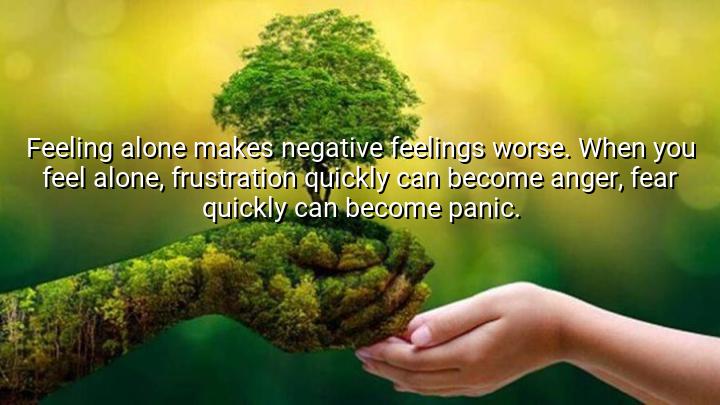




Mark Goulston’s quote emphasizes the emotional impact of loneliness on mental well-being. He suggests that when people feel alone, their negative emotions are often amplified. Frustration can quickly escalate into anger, and fear can escalate into panic when there is no emotional support or connection to help process these feelings. Loneliness creates an emotional void, and without external support, negative feelings have more room to grow and intensify.
Goulston’s insight reveals how isolation can distort emotions, making them harder to manage. Normally, frustration or fear might be temporary feelings, but in a state of loneliness, they can take on a more permanent and overwhelming nature. The absence of someone to talk to or share experiences with causes these emotions to spiral, further intensifying their impact on one's mental and emotional state.
The quote also highlights the importance of connection in emotional regulation. Goulston implies that when people have support systems—whether through relationships, friends, or communities—they are better equipped to deal with anger, frustration, fear, and other challenging emotions. The presence of others can help to balance and moderate these feelings, preventing them from becoming overwhelming or escalating into more destructive states like panic.
Ultimately, Goulston’s quote underscores the importance of social support in managing emotions. Loneliness not only exacerbates negative feelings but also makes it harder to regain emotional stability. By emphasizing the link between isolation and intensified emotions, the quote highlights the need for connection in maintaining emotional health and well-being.

TTrung
Reading this, I immediately thought about how prisons, solitary confinement especially, are designed to isolate. If emotional isolation can escalate fear and frustration so dangerously, isn’t that a form of psychological torture? It raises big ethical questions about how we treat not just prisoners, but also elderly people, or those in long-term care. Shouldn’t emotional connection be considered a basic human need, like food or water?
CLCam Le
This quote resonates so much, especially in a post-pandemic world where isolation became normal for so many. It makes me wonder—have we underestimated the long-term emotional impact of that collective loneliness? How do we rebuild our sense of community and connection now that so many people are used to being alone? And how do we reach those who’ve quietly retreated and don’t even realize how it’s affecting them?
ATAnh Tuyett
There’s something hauntingly accurate about this quote. Panic and anger don’t usually emerge out of nowhere—they’re often the result of unchecked isolation. I’m curious though, how much of this is biological versus social? Do our brains literally amplify fear when we’re disconnected from others? If that’s true, then loneliness isn’t just a feeling—it’s a risk factor. Should health care treat it with the same urgency as other illnesses?
DHD. Hang
This makes me think about people suffering in silence, especially those dealing with mental health issues. If loneliness magnifies fear and anger, how can we create low-barrier ways for people to seek help before they hit a breaking point? I wonder if peer support networks, rather than just professional counseling, might be the key to reaching people early—especially in underserved or high-stigma communities.
_CBi _nho cau
Goulston really captures something essential here. Emotional spirals seem to accelerate in isolation. But what can society do to prevent people from feeling so alone in the first place? Especially with social media giving the illusion of connection, yet so many still feel unseen. Should we be designing cities, online platforms, or workplaces differently to foster more real connection and reduce the risks of emotional deterioration?