

Fear, separation, hate and anger come from the wrong view that you and the Earth are two separate entities, the Earth is only the environment. You are in the centre and you want to do something for the Earth in order for you to survive. That is a dualistic way of seeing.
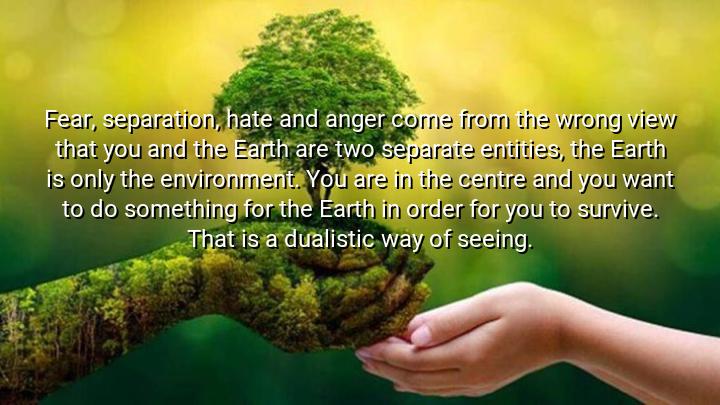




Thich Nhat Hanh's quote explores the dualistic way of perceiving the relationship between humans and the Earth. He suggests that emotions like fear, separation, hate, and anger arise from the misguided belief that humans and the Earth are two separate entities. In this view, the Earth is seen as something external to us—an environment that exists solely for our benefit and survival, rather than as a part of an interconnected whole. This sense of separation leads to feelings of alienation and conflict, both within ourselves and with the natural world.
By identifying this dualistic mindset, Thich Nhat Hanh emphasizes that it is based on a distorted understanding of interconnectedness. In contrast, he advocates for a shift in perspective where we recognize that we are not separate from the Earth but rather part of a larger, interconnected system. If we view the Earth as something external to us, we might treat it with disrespect or neglect, assuming it exists to serve our needs. However, understanding our mutual dependence with the Earth fosters a deeper sense of compassion and responsibility.
The quote encourages a holistic perspective, where humans and the Earth are seen as one, rather than two opposing forces. This shift from a dualistic to a more integrated worldview can dissolve feelings of fear and hate, replacing them with a sense of unity and peace. Thich Nhat Hanh’s teaching implies that when we let go of the illusion of separation, we open the door to greater harmony within ourselves and with the world around us.
Ultimately, the quote underscores the importance of moving beyond the dualistic perception of you versus the Earth, urging a more interconnected, compassionate, and responsible relationship with the planet. By recognizing our place in the broader ecological system, we can foster understanding, love, and mutual care, reducing the destructive emotions that arise from seeing the Earth as something "other" than ourselves.

GDGold D.dragon
Thich Nhat Hanh’s insight highlights how worldview shapes emotions and actions. If fear and anger arise from perceiving separation, could fostering interconnectedness reduce these negative feelings? How might this understanding influence conflict resolution, environmental policy, or personal relationships? It makes me wonder what daily habits or societal structures support or hinder this sense of unity.
THNguyen Van Tuan Hiep
This quote challenges the anthropocentric view that humans are the center of existence. How can we shift from a mindset of ‘doing something for the Earth’ as a means of survival to truly living as part of the Earth? What cultural, philosophical, or policy changes would support this shift? I’m intrigued by how this non-dual perspective might transform environmental activism into a practice of mutual care.
TTtrang thuy
I find the concept of dualistic thinking as the root of fear and separation profound. Does this mean that many of our anxieties come from an illusion of separateness? How can mindfulness or meditation practices help dissolve this false divide and foster a more holistic sense of self and environment? It’s inspiring to think that inner transformation might be essential for healing the planet.
HNHung Nguyen
The notion that separation causes hate and anger resonates beyond environmentalism—could it also apply to social and political conflicts? How often do divisions arise from seeing ‘us versus them’ rather than shared belonging? Thich Nhat Hanh’s words invite reflection on how unity with the Earth might parallel unity among humans. How can this philosophy be used to promote peace on multiple levels?
DCDanh Doan Cong
This quote makes me question how deeply ingrained the dualistic mindset is in modern culture. If seeing Earth as ‘only the environment’ fuels negative emotions, how can education and media help reshape this worldview? Could reconnecting with nature on a spiritual or emotional level be key to addressing global challenges like climate change and social division? I’d love to hear examples of communities living this interconnected approach.