

Fair peace becomes men; ferocious anger belongs to beasts.
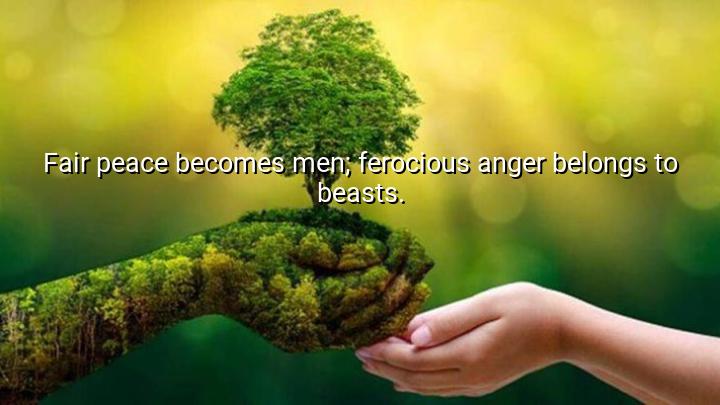




In this quote, Ovid contrasts the qualities of peace and anger, suggesting that peace is a natural and noble characteristic of humans, while anger—especially when it becomes intense or ferocious—is more fitting for beasts. Ovid implies that humans, as rational and social beings, should seek peace and harmony in their relationships and interactions. In contrast, anger that leads to violence or uncontrollable behavior degrades us, likening it to the instinctual and less civilized reactions of animals.
The quote reflects Ovid's belief in the importance of reason and self-control in human nature. Peace—as something that is harmonious and rational—is seen as something that elevates human existence, whereas ferocious anger, which can be impulsive and destructive, diminishes it. By comparing the intense emotions of anger to the behavior of beasts, Ovid is emphasizing that unchecked rage is a primitive response, one that should be avoided in favor of more thoughtful and compassionate interactions.
The origin of this quote lies in Ovid's broader exploration of human nature and its relationship to the world around us, particularly in his works like Metamorphoses and The Art of Love. Ovid, a Roman poet, often examined the dynamics between passion, reason, and the natural world, believing that the highest virtues were those that aligned with human intellect and compassion rather than base instincts. This quote encapsulates his view that peace is the ideal state for human beings, and that emotions like anger should be controlled to avoid reverting to a more savage state.
Ultimately, Ovid's quote serves as a reminder that while anger is a natural emotion, its excessive or ferocious form is destructive and contrary to the ideals of peace and reason that should govern human behavior. By cultivating self-control and seeking peace, we can avoid the primal nature of anger and live in a way that reflects our highest human potential.

HPHa Phuong
This quote succinctly captures a common belief about the civilizing effects of peace versus the destructiveness of unchecked anger. Yet I question if labeling anger as ‘beastly’ might stigmatize a natural human response. How can we encourage healthy expressions of anger without losing sight of the value peace brings? It’s a complex relationship that requires understanding both the dangers and purposes of anger.
KLKrin Lee
The quote emphasizes peace as a hallmark of humanity and anger as something more primal. I’m curious about how different philosophies and religions view anger. Are there traditions that embrace anger as a natural and even sacred emotion? Or is the ideal of peace universally considered superior? This contrast offers a lot to explore in terms of emotional intelligence and moral values.
KLNeang Kim Lien
Reading this makes me reflect on the balance between reason and emotion. If ferocious anger is beast-like, what about anger that is controlled and purposeful? Can anger be noble or constructive, or is it always something to be tamed? This quote feels like a call to rise above our baser instincts, but I wonder how achievable that really is in daily life.
TDTan Duy
This statement raises an important question about emotional control and identity. Is it possible that sometimes, expressing anger is essential to maintaining personal boundaries and dignity? Or does this quote imply that true strength lies in maintaining fairness and peace, even in the face of provocation? It challenges me to consider how cultural contexts influence our understanding of anger and peace.
TThu
I find this quote both poetic and thought-provoking. It suggests that peace is a sign of maturity and civilization, while ferocious anger is primitive. But does this view risk oversimplifying human emotions? What about situations where anger drives people to stand up against injustice? Could ferocity be a tool for survival or justice rather than just a loss of humanity?