

Expressing anger is a form of public littering.
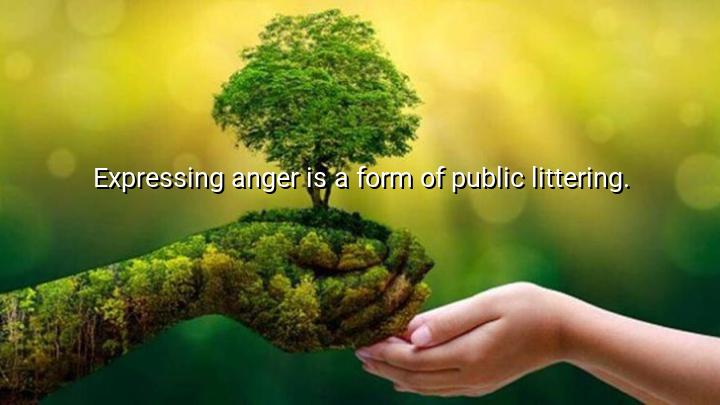




In this quote, Willard Gaylin compares expressing anger to public littering, suggesting that when we outwardly display our anger, we are essentially leaving emotional trash in the public space, disrupting the environment around us. Just as litter is an unwanted mess that harms the surroundings, anger expressed inappropriately can create an unpleasant atmosphere and impact the people around us. Gaylin’s analogy implies that displaying anger without restraint is not only inconsiderate but can also be destructive, affecting both our emotional environment and those we interact with.
Gaylin’s statement speaks to the idea of self-regulation and the importance of controlling emotions, especially in public or social settings. Instead of throwing our anger out into the open for others to deal with, we should learn to manage it privately or in a more constructive manner. This encourages emotional maturity, where we are mindful of how our feelings influence the broader environment and the people around us.
As a psychiatrist and bioethicist, Gaylin was deeply concerned with the way human emotions, like anger, are expressed and the potential consequences for individuals and society. His quote reflects his belief in the need for emotional restraint and the idea that unchecked anger can be harmful, not only to the person experiencing it but also to the people around them. The comparison to littering underscores the thoughtlessness of letting negative emotions spill out uncontrollably.
Ultimately, Gaylin’s quote serves as a reminder to be mindful of how we express our anger. Instead of contributing to emotional clutter in our relationships and communities, we are encouraged to find ways to process and express anger in a more thoughtful and responsible manner. By doing so, we protect the emotional environment around us and foster healthier interactions.

UGUser Google
Reading this, I think about the invisible consequences of unchecked anger—how it can leave lasting stains on communities and relationships. Could this perspective encourage more mindfulness in how we express frustration? Or might it lead to hiding feelings until they explode? It raises important questions about emotional health and social responsibility.
NQNguyen Tran Nhat Quynh
The idea that anger is a form of public littering implies responsibility for our emotional expressions. But how realistic is it to expect people to contain anger perfectly, especially in stressful situations? Does this metaphor risk shaming natural emotional reactions? I’m interested in how we can teach emotional regulation without stigmatizing anger itself.
DPDan PhanLinh
This quote makes me wonder about the impact of anger on social dynamics. When does expressing anger become ‘littering’ that harms relationships, and when is it simply setting boundaries? How can people express anger in ways that are respectful and constructive rather than polluting? I’d like to explore strategies for managing anger to minimize emotional damage.
HBNguyen hoa binh
I find this metaphor thought-provoking but a bit harsh. Is expressing anger really like littering, or is it sometimes necessary to clear the air and address issues? Could suppressing anger be worse, like hidden pollution? I’m curious about how cultural norms influence whether anger is seen as disruptive or as a valid emotional response.
HHna
This comparison of expressing anger to public littering is quite striking. It suggests that anger can pollute the environment around us emotionally. But does this mean all expressions of anger are harmful, or can some be constructive? How do we find a balance between being honest about our feelings and not ‘polluting’ the emotional space of others?