

Every one of us have been disappointed before and have had to go through the grieving process of anger and, you know, disappointment and then acceptance and forgiveness.
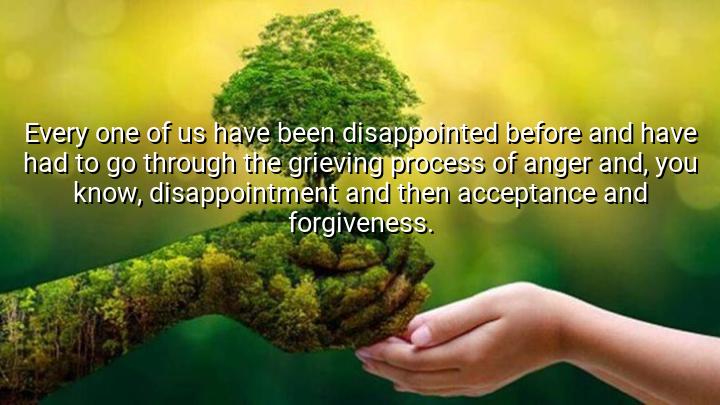




In this quote, Mathew Knowles reflects on the universal experience of disappointment and the emotional journey that follows. He outlines the stages that people often go through when dealing with disappointment, starting with anger and grief. Knowles suggests that these emotions are part of a natural progression, eventually leading to acceptance and forgiveness. This sequence represents the emotional healing process, where negative feelings are acknowledged, worked through, and ultimately released in order to find peace.
Knowles emphasizes that everyone goes through this process, regardless of the specific circumstances. Anger and disappointment are common reactions to setbacks, but they are not the final emotional states. Instead, they are steps toward emotional growth and resilience. The final stages, acceptance and forgiveness, allow individuals to move past their negative emotions and come to terms with what happened, ultimately finding emotional closure.
The origin of this quote can be linked to Knowles’ personal and professional experiences. As a manager and the father of high-profile figures in the music industry, he has undoubtedly witnessed the emotional challenges and disappointments that come with both personal and professional life. His understanding of the emotional process of grieving, acceptance, and forgiveness likely stems from these experiences and his reflections on how to cope with adversity.
Ultimately, Knowles’ quote serves as a reminder that disappointment is a part of life, but it is how we handle the subsequent emotions—anger, grief, and the eventual journey toward forgiveness—that defines our ability to heal and grow. His statement encourages the acceptance of these emotions as part of a healthy, evolving process toward emotional resolution and peace.

L8Vo Thi Truong Vy lop 8/2
Reading this, I wonder how forgiveness differs from acceptance in practical terms. Can one truly accept a hurtful situation without forgiving the person who caused it? This quote suggests a hopeful progression, but real-life experiences may not be so straightforward. It would be interesting to explore how people navigate these emotions in varied personal or cultural contexts.
NHNguyen Huy
This statement brings up questions about how we teach children and young people to handle disappointment. Are they prepared to experience these emotional stages, or are they encouraged to suppress feelings? What impact might that have on their long-term emotional health? Emphasizing forgiveness and acceptance seems crucial, but how do we balance that with healthy boundary setting?
GDGold D.dragon
I’m curious about the role of anger in this grieving process. Is anger always a necessary step before reaching acceptance, or can some people bypass it? Additionally, what strategies can help manage the anger phase so it doesn’t become destructive? This quote highlights how emotional journeys are complex and often misunderstood.
TNTuyet Nguyen
The idea of grieving over disappointment makes me think about how society often rushes people to 'get over' pain quickly. How might acknowledging these emotional stages more openly benefit mental health? Also, can understanding this process help us support others better when they face setbacks? It seems like a reminder that healing is gradual and personal.
NTNguyen thu
I appreciate the recognition that forgiveness is part of healing after disappointment. But how do we reconcile when forgiveness feels impossible? Is forgiveness always necessary for acceptance, or can someone move on without it? This quote invites reflection on the complexity of emotional recovery and whether these stages are linear or cyclical for most people.