

Culture is the arts elevated to a set of beliefs.
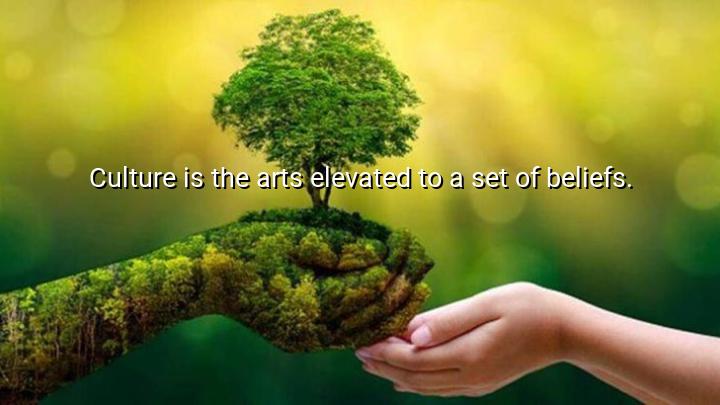




The quote "Culture is the arts elevated to a set of beliefs" by Thomas Wolfe explores the idea that culture is not just a collection of artistic works but a deeper, shared system of values and principles that arise from those works. Wolfe, an American novelist, suggests that the arts—which include literature, music, visual arts, and more—serve as a reflection of a society's collective beliefs. Through these artistic expressions, societies articulate their ideals, values, and worldview, transforming the individual expressions of art into a broader cultural identity.
Wolfe’s statement highlights the role of the arts in shaping and reflecting the moral and philosophical framework of a society. Art is not just about creating beautiful or entertaining objects; it is about representing the deeper truths and ideals that a culture holds dear. The arts serve as a mirror for society, capturing the beliefs that define it, and in turn, influencing how those beliefs evolve over time. In this sense, culture becomes an embodiment of these shared beliefs that are carried through artistic creation.
By elevating the arts to the level of beliefs, Wolfe suggests that culture is a living, dynamic force shaped by artistic and intellectual endeavors. The quote reflects the power of art to not only represent but actively shape the moral and philosophical direction of a society. What a society values is often best understood through its arts, as these creations embody and communicate the complex ideas that define its worldview.
Ultimately, Wolfe’s quote underscores the connection between art and culture. Culture is not merely the accumulation of artistic works, but the shared ideas and beliefs that these works represent and influence. The arts are the vehicle through which societies express their deepest values, and those values, in turn, become the foundation of their cultural identity.

NMHo Ngoc Nhu Mai
This statement makes me want to ask—what happens when the beliefs shaped by art are in conflict with one another? Different cultures elevate different forms of art and derive different values from them. So is culture, in this sense, inherently divisive? Or is Wolfe pointing to a universal process, even if the outcomes are unique? It’s a compelling thought—art as a kind of seed that blooms differently depending on the soil it’s planted in.
HTHien Thu
I’m intrigued by the elevation part of this quote. Does it suggest that culture is what happens when art becomes institutionalized or codified? Like when street art becomes museum-worthy, or folk music becomes national heritage? That transition seems powerful but also risky—does it strip away the spontaneity and dissent that art often carries? Is culture sometimes just sanitized art, repackaged for collective comfort rather than individual challenge?
DDden dinh
Interesting quote, but I'm not entirely convinced. Beliefs can emerge from so many other sources—religion, science, political ideologies. Can we really say that culture is mostly born from the arts? It makes me wonder if Wolfe was romanticizing the role of artists. Still, I get what he’s implying—that the arts give form and feeling to otherwise abstract ideas. But I’d like to know what he thought about the darker side of culture too.
TCThanh Cong
This quote makes me feel like there's a sacredness to art that I hadn’t fully appreciated. If culture is essentially belief, and belief stems from art, then artists are kind of like philosophers in disguise, shaping the core of how people live. But is that putting too much pressure—or power—on creatives? Do all societies elevate art to belief, or is that something more common in certain parts of the world than others?
UGUser Google
I love the idea that art becomes something greater when it’s absorbed into a shared mindset. But I wonder—does this mean culture is subjective and constantly shifting depending on what art is being celebrated or rejected at any given time? That would explain why cultural values feel so different across regions or generations. How much influence do artists actually have on what we end up believing as a society?