

In Sleep we lie all naked and alone, in Sleep we are united at the heart of night and darkness, and we are strange and beautiful asleep; for we are dying the darkness and we know no death.
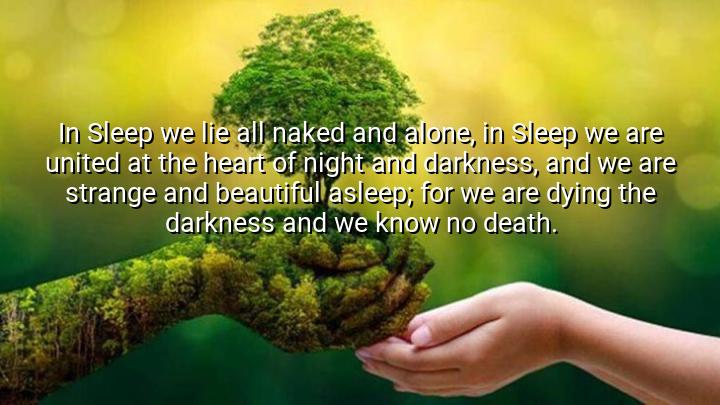




The quote "In Sleep we lie all naked and alone, in Sleep we are united at the heart of night and darkness, and we are strange and beautiful asleep; for we are dying the darkness and we know no death" is from Thomas Wolfe, an American novelist known for his deep explorations of human nature and the complexities of existence. In this statement, Wolfe reflects on the paradoxical nature of sleep—a time when we are both vulnerable and connected. He presents sleep as a state where we are alone, unconscious, and stripped of our usual defenses, yet also united with the darkness and the mystery of the night.
Wolfe describes sleep as a time of being "naked and alone", highlighting the vulnerability and isolation we experience when we rest. Yet, in this vulnerability, sleep also serves as a form of unity, as it occurs in the darkness of the night, where everyone, regardless of their waking lives, shares the same experience of unconsciousness. The imagery of being "united at the heart of night" suggests a collective experience that transcends the individual, bringing all into the same stillness and mystery.
The phrase "we are dying the darkness and we know no death" is particularly evocative. Wolfe compares the act of sleeping to a form of temporary death, a metaphorical surrender to the night where the mind is momentarily disconnected from the world. However, sleep is not true death—it is a renewal rather than an end, as we awaken to a new day. This connection between life, death, and sleep reflects a philosophical view on the cyclical nature of existence.
In essence, Wolfe’s quote invites reflection on the dual nature of sleep. It is both an experience of profound solitude and an act that connects us all in the shared mystery of night. Through the lens of sleep, Wolfe explores vulnerability, unity, and the transient nature of life and death, offering a poetic meditation on the mysteries of human existence.

BCBui Cuong
Honestly, I read this and felt this deep existential chill—but also a weird comfort. Is sleep a metaphor here for how we shed our identities each night? No pretense, no noise, just silence and solitude. But then, we all do it, together, every night. It makes me wonder if we are somehow spiritually connected in that moment, even if unconsciously. Is Wolfe hinting at a collective human soul? I can’t shake that thought.
NTTHAO TRAN NGOC THANH
The phrasing 'we are dying the darkness' really stuck with me. It almost sounds like an embrace of mortality without the finality of death. Could Wolfe be suggesting that sleep gives us access to a kind of timeless existence, free from fear? I also can’t help but wonder—why does something so essential and universal still feel so mysterious? Does our lack of understanding add to its beauty, or hold us back from appreciating it fully?
PLNguyen Phuong Linh
I'm struck by the raw vulnerability in this description. Sleep as a state where we have no defenses, no masks—just pure being. It’s beautiful but also a bit scary. In a world obsessed with control and productivity, does this idea of surrendering to darkness offer us a kind of healing? Or do we resist it too much, even subconsciously? I’m wondering if this perspective could help people with insomnia or fear of the night.
TMTrang Dang thi minh
There’s something haunting and poetic about this. It makes sleep feel like a miniature death—but also oddly comforting. I wonder, is Wolfe trying to say that sleep is a rehearsal for mortality, or a way to momentarily transcend it? I’m intrigued by the idea of being 'united' through sleep—does that speak to some collective unconscious, or just a shared human condition? Either way, it leaves me in awe and a bit unsettled.
DHDoan Thi Thu Diem Huong
This quote really makes me reflect on the mystery of sleep—how it strips us down to our essence and yet somehow connects us all. It almost sounds spiritual. Do you think sleep reveals our truest selves, or is it just a metaphor for vulnerability? And what about dreams—do they play into this 'strangeness and beauty' Wolfe mentions, or are they just random mental activity? I’d love to hear interpretations.