

Boredom, anger, sadness, or fear are not 'yours,' not personal. They are conditions of the human mind. They come and go. Nothing that comes and goes is you.
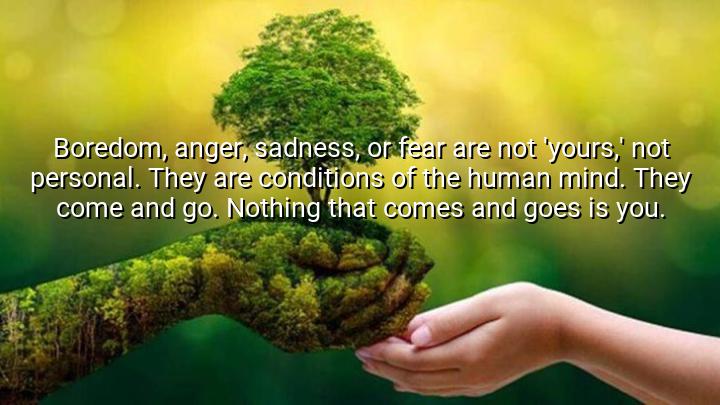




In this quote, Eckhart Tolle suggests that boredom, anger, sadness, and fear are not inherent parts of our identity; rather, they are temporary emotional states that belong to the human mind. Tolle emphasizes that these emotions are conditions of the mind, not personal attributes, and that they arise and pass away. By acknowledging that emotions like anger or fear are fleeting, Tolle encourages us to detach from them, recognizing that they do not define who we are at our core.
Tolle’s message is rooted in his teachings about mindfulness and spiritual presence. He stresses that our true nature is beyond the fluctuating states of the mind. Since emotions like sadness and fear come and go, they cannot be considered part of our identity. By realizing that these emotions are temporary, we can develop a sense of inner peace and freedom, not allowing transient feelings to control our thoughts or define our sense of self.
The origin of this quote comes from Tolle's work on spiritual awakening and emotional awareness, particularly in his book The Power of Now. Tolle emphasizes the importance of being present in the moment and recognizing the impermanence of emotions. His teachings focus on transcending the ego and emotional attachments, which often trap us in cycles of suffering and attachment.
Ultimately, Tolle’s quote serves as a reminder that negative emotions like boredom, anger, and fear are not personal flaws but natural states of the human mind. By distancing ourselves from these emotions and recognizing their transient nature, we can cultivate a deeper sense of self-awareness and inner peace, freeing ourselves from the grip of emotional turbulence.

KLNguyen Khanh Linh
This quote offers a profound way to rethink identity beyond emotional fluctuations. It makes me consider how much of our suffering is tied to over-identification with transient states. How can practices like meditation or self-inquiry help us realize this distinction more deeply? It’s a powerful reminder that who we are transcends the ebb and flow of feelings.
GNGiang Nguyen
The idea that emotions ‘come and go’ and are not ‘you’ is comforting in its impermanence. It makes me think about how this awareness might change the way we respond to life’s challenges. Does this perspective encourage resilience and flexibility? How might it influence our empathy toward others experiencing difficult emotions, knowing they are universal and transient?
THTrang Hai
This quote encourages a mindful approach to emotions, seeing them as passing phenomena rather than fixed aspects of the self. I wonder if this helps reduce suffering by creating space between experience and reaction. But could it also lead to suppression or avoidance of important emotional signals? Finding the balance between acceptance and engagement seems key.
LVSon lam Vu
Reading this, I’m curious about the implications for mental health. If emotions aren’t personal, does that mean they shouldn’t define us or dictate our actions? How can this viewpoint aid people dealing with intense feelings, like anxiety or depression? It seems like a valuable tool for mindfulness but might be difficult to apply consistently.
TTThu Thao
I find this perspective both liberating and puzzling. It suggests a separation between the self and emotions that many people struggle to maintain. How do we cultivate this awareness practically without becoming emotionally detached or numb? Also, how does this idea fit within different spiritual or psychological frameworks about identity and emotional health?