

Being told about the effects of climate change is an appeal to our reason and to our desire to bring about change. But to see that Africans are the hardest hit by climate change, even though they generate almost no greenhouse gas, is a glaring injustice, which also triggers anger and outrage over those who seek to ignore it.
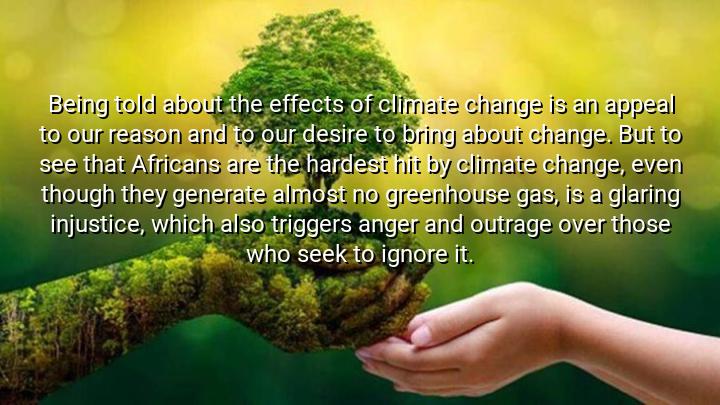




In this quote, Sigmar Gabriel addresses the global impact of climate change, noting that while discussions about its effects appeal to our reason and our desire to bring about positive change, they are often overshadowed by deeper emotional responses. Gabriel specifically highlights the injustice faced by Africans, who are among the hardest hit by climate change despite contributing almost nothing to the greenhouse gas emissions driving the crisis. This disparity between those who suffer the most and those who are responsible for the damage fuels feelings of anger and outrage.
Gabriel's statement draws attention to the ethical dimension of climate change, emphasizing that the situation is not just a matter of environmental science, but of global justice. The fact that vulnerable populations, particularly in Africa, bear the brunt of a crisis largely caused by wealthier nations' industrial activities, creates a sense of moral wrong that cannot be ignored. This injustice serves as a powerful call to action, urging people to confront and address the inequality in how climate change affects different regions of the world.
The quote also emphasizes the emotional impact of witnessing this injustice, suggesting that anger and outrage are natural responses to seeing the global community’s disregard for the lives of those most affected. Gabriel implies that these emotions should drive action, not only out of a sense of moral duty but also out of a desire to make a difference in addressing this inequality.
Ultimately, Gabriel’s words challenge us to move beyond rational discussions about climate change and focus on the moral imperative of global responsibility. By acknowledging the human toll on those least responsible for environmental degradation, he calls for a more equitable and compassionate approach to tackling climate change.

NTHuynh Trang Nguyen Thi
This really highlights the injustice of climate vulnerability. Shouldn't there be a global climate fund financed proportionally by high-emission countries specifically to support the most affected regions like Africa? I’ve heard of pledges being made, but how much of that actually turns into tangible support? It feels like wealthy nations are morally obligated to do more than make symbolic gestures.
ALnguyen anh linh
I keep coming back to the word 'ignored.' It’s chilling. If global leaders and institutions are aware of this disproportionate suffering and still turn a blind eye, isn’t that a form of passive violence? What mechanisms exist—or should exist—to hold these actors accountable for environmental negligence with human consequences? Are international courts or sanctions viable tools?
Hhuyxinhtrai
It’s striking how this quote points to the emotional disconnect in climate conversations. We’re urged to be logical, but injustice like this should make us feel uncomfortable. Should anger and outrage be more prominent tools in climate activism? Or do we risk alienating people if the messaging leans too heavily on emotional appeal instead of rational persuasion?
GBtran gia bao
This made me think about how narratives around climate change are often sanitized—data and graphs rather than faces and stories. Would it be more impactful to center the lived experiences of African communities in climate discourse? How can media and education better humanize the crisis and challenge the illusion that it’s a ‘future’ problem instead of a present-day injustice?
TNtrang nguyen
I appreciate the shift from intellectual awareness to emotional urgency that this quote invokes. But why do you think so many governments and corporations still manage to ignore such a clear injustice? Is it apathy, denial, or profit-driven self-interest? How can this kind of moral outrage be transformed into meaningful political or economic pressure from the global community?