

Art will never be able to exist without nature.
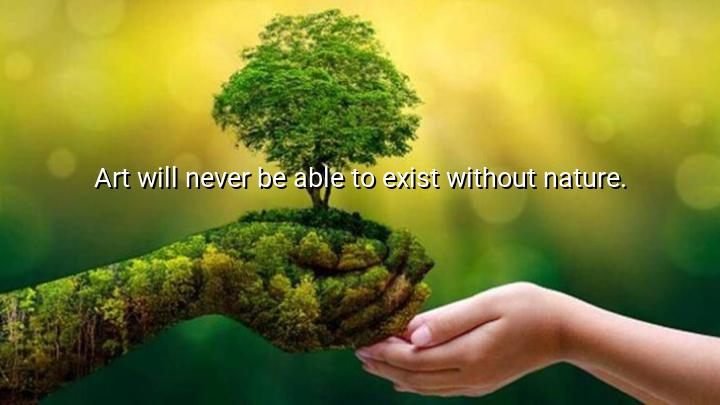




Pierre Bonnard’s quote, “Art will never be able to exist without nature,” emphasizes the deep and timeless connection between art and the natural world. For Bonnard, nature serves as the primary source of inspiration, color, form, and emotion in artistic expression. This quote reflects his belief that without the presence or influence of nature, art would lose its foundation and vitality.
As a French Post-Impressionist painter, Bonnard was known for his vivid use of color, intimate domestic scenes, and depictions of gardens, landscapes, and sunlight. His work was rooted in observation and a deep sensitivity to the visual poetry found in everyday natural surroundings. This quote encapsulates his artistic philosophy: that true creativity often begins by engaging with the organic beauty and complexity of the world around us.
By declaring that art cannot exist “without nature,” Bonnard also suggests that nature is not just subject matter—it is the essence of artistic life. It offers rhythm, texture, and balance that artists translate into their work. Even in abstract or symbolic forms, echoes of the natural world often underpin artistic choices in composition, movement, and harmony.
Ultimately, Bonnard’s quote is a tribute to the enduring role of nature as muse. It reminds us that in order to create meaningfully, artists must remain connected to the earth, the seasons, and the quiet miracles of the natural environment. Without this relationship, art risks losing its soul, its depth, and its ability to speak to the human spirit.

Hhuyen
Reading this makes me reflect on how much of art history is shaped by the natural world—whether through landscapes, materials like pigments and canvas, or even the rhythms of seasons. But with the rise of AI-generated art and synthetic mediums, is that connection being lost? Or is nature still present in ways we don’t immediately recognize, like in the logic and chaos of code?
NNNhi Nguyen
As an artist who works primarily in urban photography, I find this quote both provocative and a little limiting. It assumes nature as a prerequisite for creativity, but what about human-made landscapes or artificial constructs? Can’t those, too, evoke emotion and inspire profound artistic expression? I’d love to hear how others interpret the scope of 'nature' in this context.
18Nguyen Tu Hoang PH 1 9 8 1 8
I agree with the sentiment, especially as someone who finds nature endlessly inspiring. But I do question whether this idea is universally true. Can art be born from purely urban, man-made environments? What about dystopian or industrial themes—do they still somehow reflect nature indirectly, maybe in contrast or absence? It's an interesting lens through which to analyze different art movements.
QKtao ghet qua khu?
I find this quote incredibly grounding. It’s a beautiful reminder that no matter how abstract or modern art becomes, its roots still trace back to something organic. But I’m curious—does this mean that artists who work solely in conceptual or digital spaces are disconnected from nature? Or is 'nature' in this context more about inspiration and essence rather than physical subject matter?
CMCuong Cao Manh
This quote makes me think deeply about the interdependence between art and the natural world. If nature is the ultimate muse, does that mean as we destroy the environment, we're also endangering our capacity for genuine artistic creation? I wonder how digital art, which often feels detached from nature, fits into this idea. Can it still be meaningful, or is it missing something essential?