

Art is the triumph over chaos.
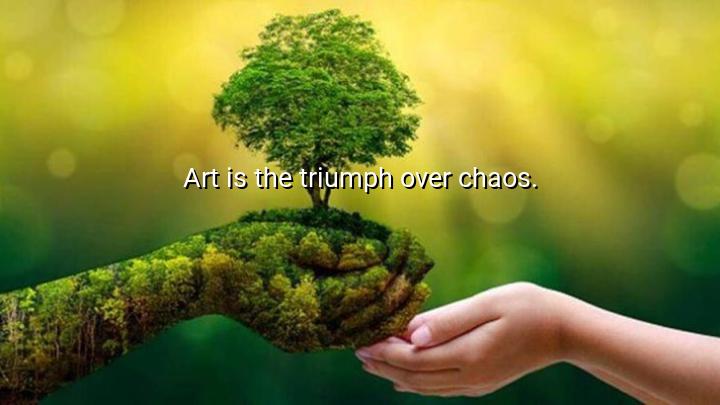




The quote "**Art is the triumph over chaos" by John Cheever suggests that art serves as a way to bring order, meaning, and structure to the disorder and unpredictability of life. Chaos represents the confusion, challenges, and complexities of the world, while art is a means of channeling these elements into something coherent and beautiful. By creating art, the artist takes the chaotic aspects of existence—whether personal struggles, societal turmoil, or emotional confusion—and transforms them into a work that provides clarity, understanding, or emotional release.
Cheever’s statement implies that the creative process itself is a battle against chaos. Through the act of creating, whether through writing, painting, music, or other forms, the artist finds ways to organize their thoughts and emotions. In this way, art becomes a form of triumph, a way of asserting control over forces that might otherwise feel overwhelming or uncontrollable. It is through art that individuals can make sense of life's chaos, finding meaning and expression in what may initially seem incomprehensible.
The origin of this quote can be traced to Cheever’s perspective on writing and storytelling. As a novelist and short story writer, Cheever often explored themes of domestic life, human frailty, and the tension between personal desires and societal expectations. His works reflect the struggle to impose order on life’s inherent messiness, and he viewed art as a way to navigate and make sense of the confusion that surrounds us.
By describing art as the triumph over chaos, Cheever emphasizes the power of creative expression to provide clarity and resolution in a world that can often seem out of control. Art offers a path forward, turning the disarray of experience into something meaningful and impactful, allowing both the creator and the audience to find peace amidst the chaos of life.

DKduy khanh
I’m intrigued by how Cheever frames art as a kind of battle. Is the artistic process inherently combative—a struggle to find clarity, form, or harmony in the midst of noise? And what does ‘triumph’ mean here? Is it enough to create something reflective or expressive, or does the art need to resonate widely to count as a true victory over chaos? This quote opens up so many nuanced interpretations.
TBPhung Tuong Bui
This quote feels especially relevant today, when the world often feels unpredictable and unstable. Is Cheever suggesting that art has a stabilizing function for society, not just individuals? If so, should we view artists as essential workers in times of crisis—like during pandemics, wars, or social upheaval? It makes me think about the role of art in collective healing and whether that’s the kind of ‘triumph’ he envisioned.
TQTien Quan
I like the idea that art is a victory over disorder, but does that suggest all art must have structure, clarity, or purpose? What about spontaneous or process-based art that resists neat conclusions? I think this quote works best when applied to the emotional or psychological realm—when you're able to create meaning or beauty from personal chaos, even if the result doesn’t look orderly in a traditional sense.
BDTran Trong Bao Duy
Cheever’s quote makes me think about how artists often work through trauma, confusion, or anxiety by channeling it into their work. But does the transformation of chaos into something structured mean that the chaos is conquered—or just reinterpreted? I’m curious how different artists might interpret this. Is the ‘triumph’ in the process, the final product, or simply the courage to engage with chaos at all?
HNHang Nga
I wonder if this quote implies that chaos is the natural state of things and that art somehow imposes meaning. But is that always true? Some forms of art seem to embrace disorder—like abstract expressionism or surrealism. Couldn’t those be seen as celebrating chaos rather than triumphing over it? Or is the act of expression itself a form of control, no matter how chaotic the content appears?