

Homesickness is nothing. Fifty percent of the people in the world are homesick all the time.
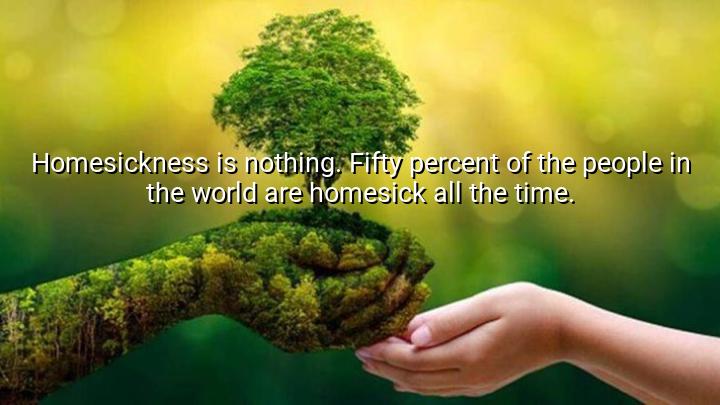




The quote "Homesickness is nothing. Fifty percent of the people in the world are homesick all the time" by John Cheever reflects on the universal and often persistent feeling of longing for one's home. Cheever downplays the concept of homesickness, suggesting that it is a common experience, felt by many people at different times, regardless of their circumstances. He points to the idea that the feeling of missing home is not necessarily a rare or overwhelming condition but something that is part of the human experience for a large portion of the population.
Cheever’s words speak to the emotional pull of home and the sense of belonging that many individuals crave. Homesickness often arises when someone is far from their roots, but Cheever implies that this longing is not confined to physical separation alone. It can be a more profound, ongoing emotional state where people feel disconnected from their sense of home, whether due to changes in life circumstances, personal identity, or even a longing for familiarity and comfort that cannot always be easily obtained.
The origin of this quote ties into Cheever’s writing, which often explored themes of alienation, identity, and the complexities of modern life. He understood that homesickness is not just about missing a physical place, but also about feeling out of place in one’s own life or environment. His quote suggests that the feeling of yearning for something familiar is a pervasive condition, affecting people from all walks of life, regardless of where they are physically located.
Ultimately, Cheever’s statement offers a perspective on the universality of homesickness. It challenges the idea that longing for home is something to be ashamed of or something experienced only by a few. Instead, it highlights that feeling homesick is a natural and frequent part of the human condition, shared by many, and it is a part of the complex emotional landscape of what it means to feel connected to both people and places.

AAdministratorAdministrator
Welcome, honored guests. Please leave a comment, we will respond soon