

Art is the tree of life. Science is the tree of death.
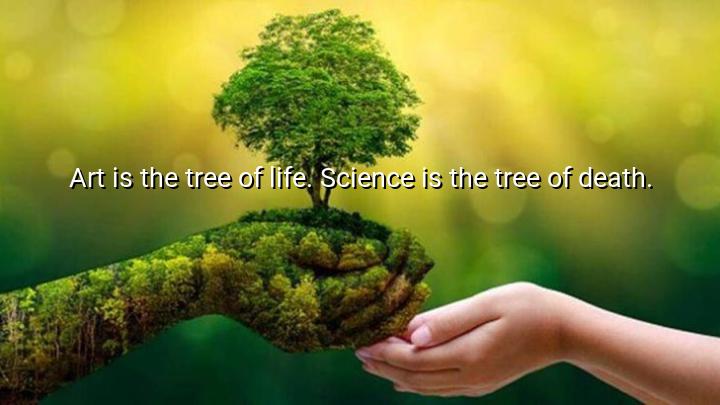




William Blake’s quote, “Art is the tree of life. Science is the tree of death,” reflects his deeply symbolic and spiritual view of art and science as opposing forces in human experience. By declaring art the “tree of life,” Blake suggests that it is a source of creativity, imagination, and spiritual nourishment. Art, in his view, is life-giving—it connects people to their emotions, inner truths, and the divine.
In contrast, Blake calls science the “tree of death,” not because he opposed knowledge, but because he feared the dominance of rationalism and mechanical reasoning at the expense of intuition and spiritual insight. During the late 18th and early 19th centuries, the Enlightenment’s focus on logic, empirical evidence, and material progress deeply concerned Blake, who believed that such an approach could suppress human imagination and disconnect individuals from the sacred aspects of life.
As a Romantic poet, artist, and mystic, Blake often used vivid metaphors to challenge conventional thinking. His works, including The Marriage of Heaven and Hell and Songs of Innocence and of Experience, reflect his belief in a world where vision, emotion, and symbolism were more vital than cold, analytical thought. This quote encapsulates his lifelong struggle to defend spiritual freedom and artistic expression against what he saw as the soul-numbing effects of scientific reductionism.
Ultimately, Blake’s quote is a poetic call to restore balance between the mind and the soul. While modern readers may see value in both art and science, Blake’s warning remains relevant: when rationality overtakes imagination, and facts silence feeling, humanity risks losing touch with the very things that make life meaningful, vibrant, and alive.

CDChi Dung
I'm struck by how Blake frames this almost like a moral dichotomy—art as life-giving and science as life-taking. Is that a poetic exaggeration, or does it reflect a deeper fear of what science becomes when detached from emotion and ethics? I wonder how this perspective fits with today's conversations about AI and biotechnology. Can art help humanize science before it leads us down dangerous paths?
VNVinh Nguyen
This quote feels like a bold rejection of rationalism. It makes me think—can art really exist without science in today’s world? Digital art, film, even musical instruments rely on scientific principles. So maybe the two trees are more intertwined than Blake admits. I’d love to hear if anyone's written a modern response to this quote that reimagines art and science as partners instead of opposites.
LNDoan Le na
I’m intrigued by Blake’s view here. Do you think he meant ‘science’ in the Enlightenment sense—as something that strips mystery from the world? Maybe to him, science reduces things to facts, while art uplifts spirit and wonder. But that makes me ask: is it possible for science to be beautiful and awe-inspiring in its own right? Or is Blake suggesting that only art connects us to something eternal?
MLMinh Luyen
I find this quote haunting and a bit extreme. It paints science as inherently destructive, which seems unfair. Hasn’t science given us as much life as art—think of vaccines, clean water, or even the technology that lets us share art globally? I think Blake was being symbolic, maybe warning against a world driven purely by logic. But in practice, aren't both needed to thrive?
NTBich Nhung Tran
Blake’s statement really challenges the modern mindset. I wonder if he's reacting to the coldness or dehumanization that sometimes comes with scientific progress. But is it fair to contrast art and science so drastically? Can't science also preserve life—through medicine, technology, and sustainability? Maybe the issue is when science is used without ethics or soul, which is where art steps in to remind us of our humanity.