

Art is not what you see, but what you make others see.
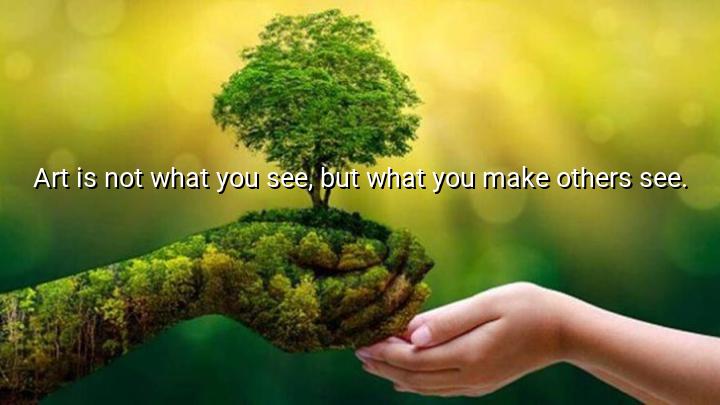




The quote "Art is not what you see, but what you make others see" by Edgar Degas suggests that the true power of art lies in its ability to evoke emotions, ideas, and interpretations in the viewer. Degas is emphasizing that art is not just a direct representation of the artist's perception, but rather an act of communication, where the artist’s intent is to guide the viewer's own perception and create new perspectives. The artist’s job is not simply to replicate reality, but to shape how others engage with and understand the world through their work.
Degas, a renowned French Impressionist painter and sculptor, was known for his ability to capture movement and human emotion, especially in works like his ballet scenes. His focus was not on creating photographic representations of the world but on portraying the dynamic and emotional qualities of his subjects. This quote reflects his belief that art goes beyond simple observation and should evoke deeper responses from the audience, encouraging them to see things in a way they might not have considered before.
The origin of this quote lies in Degas's artistic philosophy, which often focused on the subjective experience of the viewer. Rather than just painting what he saw, he sought to provoke thought and emotion, encouraging the audience to interpret the world through his lens. This perspective aligns with his style, which was more focused on light, shadow, and human interaction than on precise detail or traditional representation. Degas's view of art emphasizes the transformative power of the artist's vision in reshaping the viewer's understanding of the world.
For artists, this quote underscores the importance of impact and communication in their work. Degas encourages creators to think about how their art influences and engages the viewer, shaping how others see and understand the world. It suggests that the true measure of art is not in how accurately it reflects reality, but in its ability to create new perspectives and emotional responses in those who experience it.

PSPhuoc sang
There’s a quiet arrogance in this quote that I find strangely compelling. It assumes the artist knows more than the viewer, that they can uncover a hidden truth others might miss. Is that the essence of genius in art—showing us something that’s always been there but invisible to most? Or is this perspective too elitist? Does it overlook how viewers bring their own vision and meaning to what they experience?
SNSang Nguyen
Is Degas talking about manipulation in art—like steering an audience’s emotions or thoughts—or is this more about offering a new perspective? There’s a subtle difference. One is about control, the other about possibility. I wonder if the effectiveness of art lies in its ability to gently reframe the familiar into something profound, without forcing a specific reaction. Can artists ever truly predict what others will see in their work?
NTNhi Tang
I love how this flips the common idea that art is all about personal expression. This quote makes me think of art as an invitation to perception—a kind of emotional or intellectual collaboration between artist and audience. How do you even begin to train yourself to see through another person’s eyes and then try to construct something that moves them? It's fascinating and overwhelming at the same time.
N8Quach Ai Nhi 8a4
Degas’s quote honestly feels a little intimidating as someone who dabbles in art. It implies a responsibility—not just to create, but to guide, to influence, to provoke vision in others. What if I don’t know what I want people to see? Does that make the work less meaningful? It makes me wonder whether the artist always needs intention behind the message, or if ambiguity can be just as powerful.
VMYen Vy Ma
I feel like this speaks directly to the communicative power of visual art. It’s not just about technique or what’s on the canvas—it’s about evoking a deeper understanding, a reaction, an emotion in someone else. But how much control does the artist really have over what others see? Is the meaning of art something the artist can shape, or does it always get filtered through the viewer’s own lens?