

Art is not a study of positive reality, it is the seeking for ideal truth.
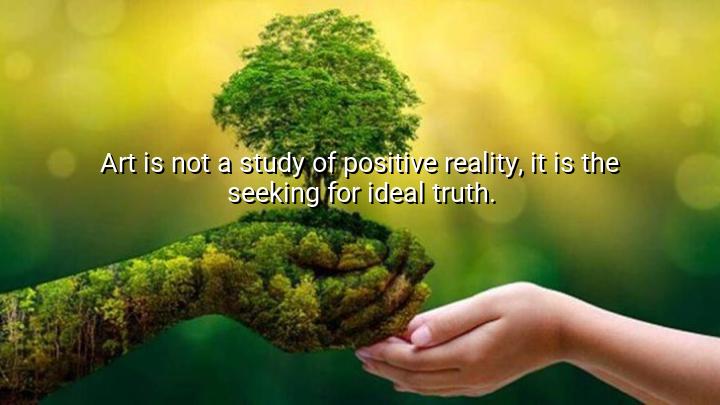




The quote "Art is not a study of positive reality, it is the seeking for ideal truth" by John Ruskin challenges the notion that art should simply replicate the world as it is. Ruskin, a renowned English art critic and social thinker, suggests that art is not about capturing the exact, observable details of the physical world, but about seeking a deeper, more ideal truth that transcends the surface. The focus of art, in Ruskin's view, should be on expressing higher, often abstract concepts of beauty, morality, and truth, rather than merely depicting the world as it appears.
Ruskin’s perspective reflects a broader 19th-century artistic movement that emphasized the emotional and philosophical aspects of art, rather than its mere visual representation. Art, according to Ruskin, is a means of searching for a truth that lies beyond the tangible, material world. This ideal truth could be a reflection of the artist's inner vision or a representation of universal ideals, such as beauty, justice, or spirituality, that cannot be fully captured in the concrete details of everyday life.
The idea of art as the pursuit of ideal truth also aligns with Ruskin’s belief in the moral and educational power of art. He argued that true art should uplift and inspire, teaching viewers to look beyond the ordinary and to strive toward higher ideals. In this way, art becomes a transformative process, guiding both the artist and the observer toward a deeper understanding of the world and the truths that shape it.
Ultimately, Ruskin’s quote emphasizes the philosophical and aspirational nature of art. Rather than focusing solely on the material world, art seeks to illuminate universal truths and ideals that resonate with the human experience. Through this pursuit, art elevates the spirit and encourages individuals to explore the deeper dimensions of life and reality.

TCNguyen Thuy Cham
I’m intrigued by the idea that art isn’t bound by the ‘positive reality’ we live in, but I wonder if this means that art could lose its grounding in the human experience. Can art seek truth if it’s not connected to reality in some way? Or is the very act of seeking ‘ideal truth’ what connects it to humanity, even if the ‘truth’ it finds is subjective or abstract?
NVHien Luong Nguyen Vu
Ruskin’s definition of art as a search for ideal truth brings up an important point—art’s role is not just to mirror the world but to seek something deeper, something beyond the surface. Does this mean that the artist is always pushing against the constraints of reality? How much freedom does an artist have to pursue ‘ideal truth’ if they are still grounded in a society that expects art to reflect ‘what is’ rather than ‘what could be’?
TTNguyen Thi Thuy
This quote makes me think about the tension between idealism and reality. If art is a search for an ‘ideal truth,’ then is it always striving for something beyond what we can see or understand? Is that why art has the power to evoke such strong emotions—it touches on something we can’t fully grasp, something beyond our immediate experience? Does this idealized search also make art timeless, since it’s never about ‘what is’ but about ‘what could be’?
MPNguyen Vu Minh Phuong
Ruskin seems to suggest that art should transcend the mundane and touch on deeper truths. But is that even possible? Can art ever truly escape the reality it’s rooted in, or is it always a reflection of the artist’s perspective? Can the search for ‘ideal truth’ sometimes blind an artist to the reality they’re trying to depict, leading to work that feels disconnected from the world around them?
TNNguyen thi ngan
I love the idea that art is about seeking ideal truth, but I wonder what that means in the context of abstract art or modern interpretations. If artists aren’t depicting the ‘real’ world directly, are they still searching for truth? Does ideal truth require representation, or can it be something more abstract, like a feeling, emotion, or concept that can’t be easily captured in ‘reality’?