

Art is a step from what is obvious and well-known toward what is arcane and concealed.
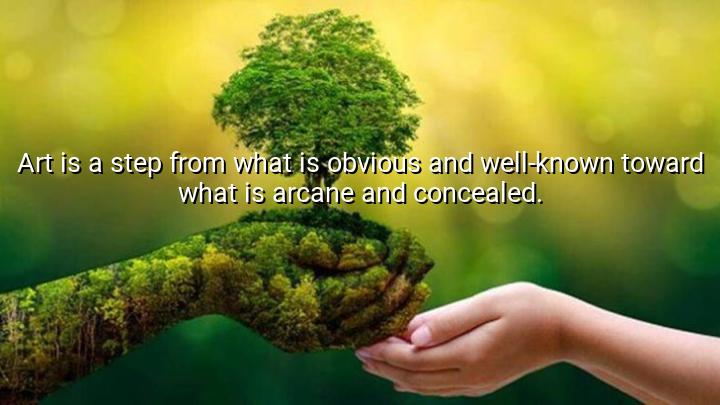




The quote "Art is a step from what is obvious and well-known toward what is arcane and concealed" by Khalil Gibran emphasizes the transformative and exploratory nature of art. Gibran, a Lebanese-American poet and philosopher, suggests that art moves beyond surface-level appearances, pushing boundaries and uncovering deeper truths. While the obvious represents what is familiar and easily understood, art seeks to transcend this, moving toward the arcane—that which is hidden, mysterious, and often difficult to comprehend.
By describing art as a step from the well-known to the concealed, Gibran points to the role of art in revealing new perspectives. It’s not just about capturing what is easily seen, but about exploring the unknown and shedding light on aspects of life, the human condition, and the universe that are often overlooked or misunderstood. Art becomes a journey from certainty to uncertainty, where artists venture into realms that challenge conventional thinking and provoke deeper contemplation.
Gibran’s quote also suggests that art is an act of discovery, both for the artist and the viewer. It requires a willingness to step into the unknown and embrace the complexity of emotions, ideas, and experiences that might not be immediately accessible or understandable. Through art, we are invited to move beyond the surface and explore the hidden layers of reality, often confronting that which is arcane or mysterious.
Ultimately, Gibran’s words remind us that art is not merely a reflection of the familiar, but a vehicle for discovering the deeper, more profound aspects of existence. It is a step into the concealed, challenging us to look beyond what is obvious and explore the richness and mystery that lie beneath the surface.

2N27. Nhiii
Gibran’s view that art moves from the obvious to the concealed makes me curious: is art more valuable when it requires exploration, or is there power in simplicity? Should art always leave us with something to uncover, or can it simply reflect what’s already known in a new way? What do you think – does art have to be mysterious to be profound, or can it be impactful by just illuminating what’s already there?
QNQuynh Nguyen
I love the idea of art as a bridge to the hidden and the arcane. It makes me think about the layers of meaning in every work of art. But can something that is too obscure actually hinder our ability to connect with it? At what point does the complexity in art become an obstacle rather than a revelation? How do we decide if a piece of art is worth delving into or if it’s too obscure to appreciate?
TTNguyen Ha Thanh Truc
This idea from Gibran feels like art’s journey of transformation. It’s as though he sees art as a way to move beyond what we already know, towards something that’s more hidden and mysterious. But does this mean that all great art must be elusive and difficult to understand? Can art still be meaningful if it’s more straightforward, or is there always a need for depth and complexity to make it truly valuable?
NUNha Uyen
I find Gibran’s quote intriguing because it suggests that art is not just about presenting what’s easy to see, but about uncovering what’s beneath the surface. But what happens when the art is so ‘arcane’ or ‘concealed’ that it becomes inaccessible or incomprehensible? Is the role of art to always pull us deeper into complexity, or does it also serve the purpose of communicating something immediate and understandable?
TDLe Vu Thuy Duong
Khalil Gibran’s idea that art is a journey from the obvious to the hidden makes me wonder: does this imply that all art should challenge the viewer to discover something deeper? If art is meant to unveil the concealed, how do we balance between complexity and accessibility? Could it be that art loses its power when it becomes too obscure? What’s your take on the balance between the obvious and the hidden in art?