

Art has the power to transform, to illuminate, to educate, inspire and motivate.
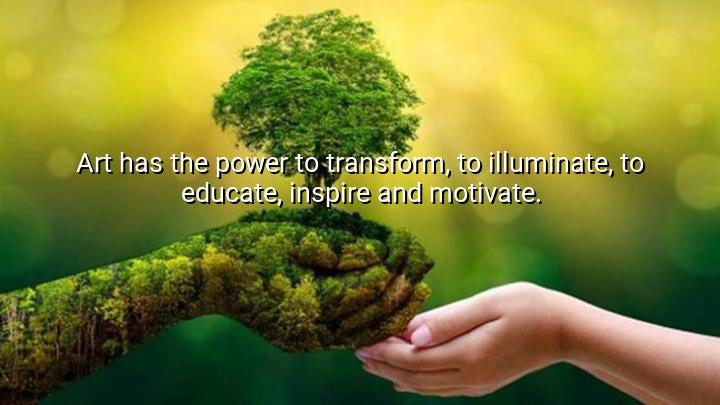




The quote "Art has the power to transform, to illuminate, to educate, inspire and motivate" by Harvey Fierstein highlights the profound impact that art can have on individuals and society. Fierstein, an American actor, playwright, and activist, suggests that art is not just an aesthetic experience, but a powerful force that can create change. Through its various forms, art has the ability to transform perspectives, shedding light on new ideas, emotions, and social issues.
Fierstein emphasizes that art is not passive; it illuminates hidden truths and offers new ways of thinking. Whether through visual art, theater, music, or literature, art can reveal insights into the human experience, the world around us, and the complexities of society. By educating and inspiring individuals, art encourages a deeper understanding of the world and prompts personal growth and reflection.
Moreover, the quote suggests that art has the capacity to motivate people to take action or make positive changes. It can move audiences emotionally and intellectually, spurring them to pursue social or personal transformation. Art is often used as a tool for advocacy and activism, where it amplifies voices, challenges norms, and encourages people to engage with the world in meaningful ways.
Ultimately, Fierstein’s quote emphasizes that art is a transformative, dynamic force. It has the ability to influence society and individuals alike, offering more than just entertainment—it becomes a tool for growth, change, and empowerment. Through its power to educate, inspire, and motivate, art becomes an essential part of the human experience, helping us to understand, reflect, and move forward in the world.

BNBao Nhi
Fierstein’s quote really got me thinking about the role of art in education. Should art be more central in school curriculums—not just as a subject, but as a method of teaching other subjects? Imagine learning history through theater or science through sculpture. Could that interdisciplinary approach help students connect more deeply with material? I’d love to know if any schools are already doing this successfully.
TAPham Thao Anh
I love the idea that art can illuminate and inspire, but I also think it can provoke and challenge—which is just as important. Do we sometimes sanitize the idea of what art is supposed to do? Shouldn't transformation include discomfort, confrontation, even confusion? I’d be interested in hearing more about how controversial or politically charged art fits into this vision.
MDHa My Dung
This quote makes me think about public funding for the arts. If art can transform and educate, why do so many governments treat it as a luxury rather than a necessity? Shouldn’t more investment be going into schools, public art programs, and community theater? I feel like we’re underestimating how essential art is for emotional well-being and social awareness.
HHuy
I completely agree with the sentiment, but I wonder—does everyone experience art in these ways? Can art really motivate or educate someone who isn’t naturally drawn to it? Sometimes I feel like the impact of art depends a lot on the viewer’s openness or cultural background. How universal is this power, and can it truly reach people across different walks of life equally?
NHNguyen Hanh
This quote feels incredibly validating for those of us who turn to art during difficult times. But it also makes me curious—how exactly does art inspire or educate in ways that other mediums can’t? Is it the emotional connection, the visuals, the storytelling? I’d love to hear more about what makes art such a uniquely transformative tool compared to something like a textbook or a speech.