

State-sanctioned marriage is a civil contract, period. A contract is not a judgment of moral value. It is a legal agreement between two parties that testifies to a meeting of minds between those consenting entities. It is not a religious act or rite and so has nothing to do with Adam and Eve or Steve or even Harvey.
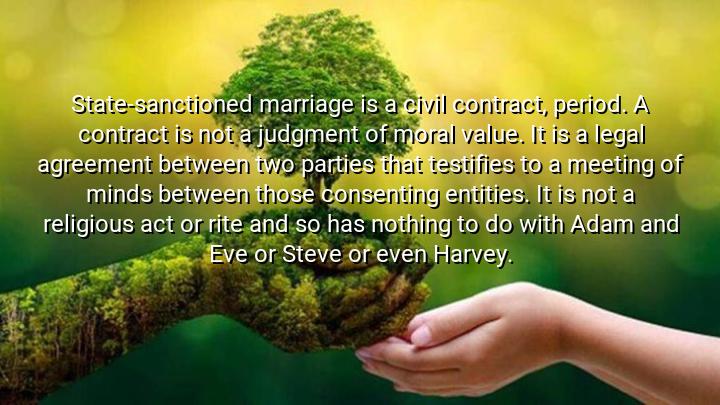




In this quote, Harvey Fierstein, a celebrated actor, playwright, and LGBTQ+ rights advocate, makes a clear distinction between state-sanctioned marriage and religious or moral views surrounding the institution. He asserts that marriage is fundamentally a civil contract rather than a moral or religious rite. Fierstein emphasizes that a contract is a legal agreement between two consenting parties, focused on mutual consent and legal obligations, rather than on moral judgment or religious significance.
The origin of this statement likely comes from Fierstein’s advocacy for same-sex marriage and his efforts to redefine the institution in legal terms. He highlights that while marriage is often seen through the lens of religious traditions (such as the story of Adam and Eve), it is, in its essence, a legal process that does not require religious justification. By mentioning Steve and Harvey, he expands the concept of marriage beyond traditional religious interpretations, pointing out that individuals of all sexual orientations should have the same legal rights when it comes to marriage.
Fierstein’s quote challenges the argument often made by critics of same-sex marriage, who invoke religious or moral frameworks to oppose it. He is advocating for the recognition of marriage as a legal contract, where the individual rights of consenting adults should be prioritized over religious doctrines or traditional views on marriage. This perspective emphasizes equality and civil rights, particularly for LGBTQ+ individuals, in the context of marriage laws.
Ultimately, Fierstein’s statement serves as a reminder that marriage should be viewed as a legal institution, one that guarantees rights and responsibilities to those who choose to enter into it, rather than as a religious or moral judgment. His quote advocates for a more inclusive understanding of marriage that respects legal equality, regardless of individuals' gender, sexual orientation, or religious background.

AAdministratorAdministrator
Welcome, honored guests. Please leave a comment, we will respond soon