

Art distills sensations and embodies it with enhanced meaning.
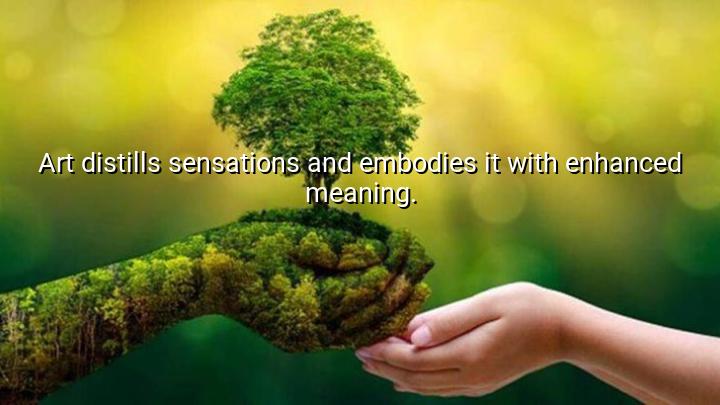




In this quote, Miguel de Unamuno explores the transformative nature of art. He suggests that art takes raw sensations—the immediate experiences or emotions we encounter in life—and refines them, giving them new meaning. By "distilling" sensations, art does not just capture what we see or feel; it amplifies and refines those experiences, offering a deeper understanding of the world around us. Unamuno implies that the essence of life is more clearly revealed through the lens of art, allowing us to see beyond surface-level experiences.
The origin of the quote lies in Unamuno's philosophical views on the human condition. As a writer and philosopher, Unamuno believed in the power of art to help us make sense of the complexities of existence. His works often grappled with questions of identity, meaning, and the nature of life and death, which aligns with his understanding of art as a tool for capturing the profound subtleties of human experience.
Through this quote, Unamuno emphasizes the elevating effect of art. It is not just a mirror of reality, but a magnifier of experience, one that enhances and deepens the significance of the sensations it embodies. This view positions art as a transformative force, capable of providing insights that may otherwise be overlooked in daily life.
Unamuno’s belief that art adds meaning to our sensations ties into the broader philosophy of art as a means of understanding and interpreting the world. He proposes that art has a unique power to take the fleeting, ephemeral moments of human existence and infuse them with lasting significance, giving us the ability to reflect, question, and ultimately find deeper meaning in life itself.

CACat Anh
This quote speaks volumes about the role of the artist as both interpreter and amplifier. But it raises a tricky question: how do we know when art has successfully distilled sensation and when it’s just an overload of emotion without clarity? Sometimes I look at abstract art and wonder what’s being embodied, if anything. Maybe the value lies not in clear meaning but in creating space for different interpretations.
CQDien Chinh Quoc
I find this idea compelling because it explains why certain pieces of art resonate so strongly—they’ve captured and clarified something we feel but can’t articulate. Do you think artists are naturally more in tune with their emotions, or do they just have better tools for translating them? Also, how much of the 'enhanced meaning' is intentional, and how much arises from how people interact with the work over time?
QVNguyen Cao Quan Vinh
There's something beautiful about thinking of art as a vessel for sensations. But I wonder, is it possible for the process of distilling feelings into art to dilute them instead of enhance them? Can the effort to craft something meaningful strip away the original intensity of the experience? I'm torn—on one hand, art adds meaning, but on the other, can it unintentionally tame the wildness of raw emotion?
TTLe Thanh Tam
Miguel de Unamuno’s statement intrigues me—especially the idea of 'enhanced meaning.' Who determines that enhancement? Is it the artist, the viewer, or society over time? It seems like art isn't just about expressing emotions, but refining and elevating them. That suggests a kind of alchemy. Can art lose its impact if it's too raw and doesn't go through this 'distillation' process? I’d love to hear thoughts from others on this.
DTTran Dang Thuan
This quote really makes me think about the transformative power of art. It's fascinating how a fleeting emotion or a brief moment can be translated into something permanent and profound. Do you think this process of distilling sensation into meaning is what separates art from mere decoration? I'm curious whether all forms of art succeed in doing this, or if only certain works truly embody that depth of feeling and understanding.