

Anger is the enemy of non-violence and pride is a monster that swallows it up.
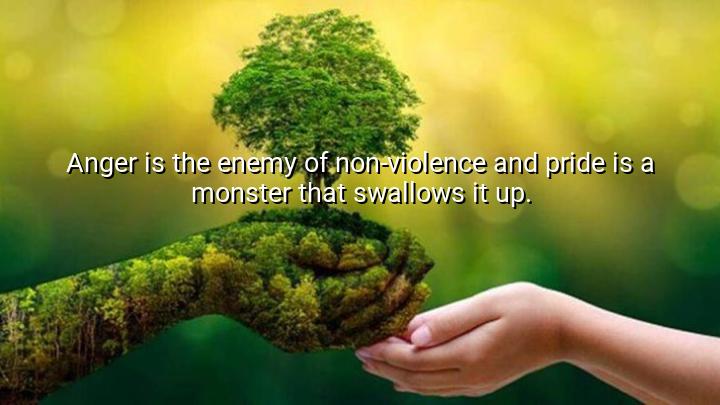




In this quote, Mahatma Gandhi highlights the destructive power of anger and pride in hindering the principles of non-violence. He asserts that anger directly opposes non-violence, suggesting that when we act out of anger, we are more likely to resort to violence or harmful actions. Additionally, he points out that pride exacerbates this by "swallowing up" anger, implying that pride causes us to hold onto negative emotions rather than releasing them in a peaceful, constructive way. Both anger and pride become obstacles to maintaining peace and harmony.
Gandhi’s statement reflects his deep belief in the power of ahimsa (non-violence) as a guiding principle for personal conduct and societal change. He teaches that when we allow anger to take hold, we are essentially allowing violence and aggression to dictate our behavior, which directly contradicts the core values of non-violence. Similarly, pride—a feeling of superiority or arrogance—prevents us from letting go of anger, as it makes us less willing to forgive or understand others.
The origin of this perspective comes from Gandhi’s life and philosophy, particularly his commitment to non-violence and peaceful resistance during India’s struggle for independence. Gandhi recognized that true freedom and justice could only be achieved through peaceful means, and that anger and pride often clouded the path to those ideals. His own practice of self-discipline and emotional control served as a model for others who sought to follow the principles of non-violence in their lives.
Ultimately, Gandhi’s quote serves as a reminder that both anger and pride are barriers to peace and non-violence. By acknowledging these emotions and working to control them, we can move toward more peaceful and compassionate interactions, both within ourselves and with others. Gandhi urges us to prioritize humility and restraint, understanding that true strength lies in maintaining inner peace and emotional balance.

ASThao a sau
This quote prompts me to ask: Is pride always detrimental to non-violence, or can it be redirected into a constructive force, like pride in one’s values or community? Also, how do different cultures interpret pride in relation to anger and peace? Understanding this could shed light on why some movements succeed peacefully while others fall into violence, despite similar intentions.
BTNguyen Bao Tram
Gandhi’s insight suggests that non-violence isn’t just about controlling anger but also managing pride. In practical terms, how might this apply to everyday situations where ego clashes ignite conflicts? Could fostering empathy and humility serve as antidotes to both anger and pride? I’m interested in perspectives on whether pride always undermines non-violence or if it can sometimes coexist without causing harm.
Ttttj
The metaphorical language here is so vivid—pride as a monster that swallows anger. Does this mean pride hides anger inside, making it harder to confront or resolve? Or might it imply that pride turns anger inward, leading to silent conflicts? How can one differentiate healthy pride from the kind that undermines peaceful intentions? This raises questions about emotional intelligence and self-awareness in the practice of non-violence.
MTLe Thi Minh Thu
I find it fascinating that anger is called the enemy of non-violence, but pride is described as a monster that consumes anger. Could this suggest that pride not only swallows anger but also distorts the path of non-violence by making it self-centered? How can individuals cultivate humility to keep both anger and pride in check while striving for peace? This feels deeply relevant to both personal growth and social justice.
VHPhan Van Hien
This quote highlights how subtle emotions can undermine noble ideals. Is it possible that pride, often seen as a positive trait, can be the very force that destroys the foundation of non-violence by feeding anger indirectly? How do leaders and activists guard against this ‘monster’ to stay true to peaceful resistance? I’m curious if recognizing this dynamic early can prevent escalation in tense situations.