

Anger is like those ruins which smash themselves on what they fall.
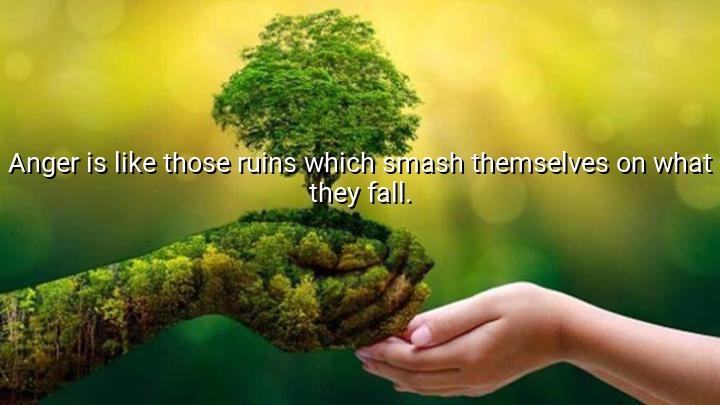




In this quote, Lucius Annaeus Seneca uses the metaphor of ruins to describe the destructive nature of anger. He suggests that just as ruins collapse and cause damage to whatever they land on, anger similarly harms the person who experiences it and everything around them. Seneca emphasizes that anger is not only destructive to its target, but it also self-destructs, leaving the individual who is angry in a worse state than before.
Seneca's comparison of anger to ruins implies that it is an uncontrollable force, one that spreads destruction without regard for consequences. The moment anger is unleashed, it often leads to unintended harm, both to the individual experiencing the emotion and to others involved. This idea aligns with Seneca's broader Stoic philosophy, which teaches the importance of mastering emotions to avoid personal turmoil and external harm.
The quote also reflects Seneca’s belief that anger, when left unchecked, is ultimately self-destructive. Just as the ruins that collapse on what they fall are irreparable, anger damages relationships, reputations, and the mental well-being of those who succumb to it. In this sense, anger is a force that causes long-term damage, even to the person who holds it.
Ultimately, Seneca's quote serves as a reminder of the importance of emotional control. He warns that anger can be a force that not only harms others but also the person who carries it. By understanding the self-destructive nature of anger, Seneca encourages the cultivation of inner peace and restraint, core tenets of Stoicism.

VAVan Anh
I feel like Seneca nails something deeply human here. Anger often feels powerful, even righteous—but then it leaves you feeling empty or guilty. Why does it so often seem to punish the angry person more than the person it's directed at? Is that just how emotion works, or is it a consequence of how society responds to displays of anger? I’d like to understand the cultural factors at play.
TLPhan Thuy Linh
This quote is hauntingly accurate. It makes me think about the long-term consequences of holding grudges or refusing to forgive. But here's the dilemma: what if the anger is justified, like in cases of abuse or injustice? Are we expected to let it go just to avoid self-destruction? How do we reconcile the need for justice with the need for inner peace without suppressing the truth?
ISInh Shu
There’s something tragic about this idea. Do you think people who hold onto anger are even aware of the damage they're doing to themselves? Or is it something we only realize in hindsight, after the ruin has already occurred? I find myself asking: how can we recognize the tipping point before anger turns inward and starts eroding our well-being or relationships beyond repair?
TThao
From a modern psychology perspective, how does this metaphor align with our understanding of emotional health? It feels like Seneca is warning us that anger is a self-destructive impulse. But can repression be even worse? I wonder how ancient Stoic views like this compare to modern therapeutic approaches that encourage emotional expression. Is there a balance between feeling anger and not being consumed by it?
•L•Æ lanッ
This quote made me reflect on how many times I've lashed out in anger and regretted it later. It really makes me wonder: is anger always irrational, or is it our inability to express it constructively that causes the ruin? I’d love to hear a philosophical take on whether anger can ever be a source of wisdom, or if it’s just something to overcome or eliminate entirely.