

Anger is a great force. If you control it, it can be transmuted into a power which can move the whole world.
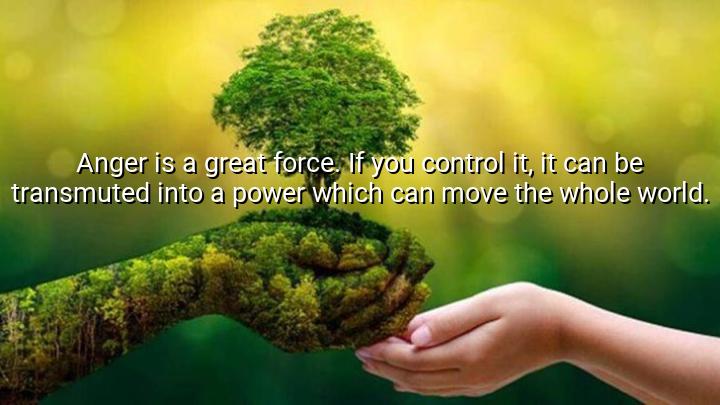




In this quote, William Shenstone acknowledges that anger is a powerful emotion, capable of driving action and change. He suggests that while anger can often be destructive if left unchecked, it also holds great potential if controlled. Shenstone emphasizes that when one is able to manage and harness anger, it can be transformed or transmuted into a force that can influence and even "move the whole world."
Shenstone’s idea centers on the concept of self-control—that the key to unlocking the true power of anger lies in the ability to channel it positively. Instead of letting it lead to negative outcomes like destruction or conflict, one can use it to fuel productive change, push for justice, or inspire others. This perspective speaks to the importance of emotional intelligence and the capacity to direct intense emotions toward meaningful goals.
The quote also highlights the transformative nature of anger. Rather than viewing it as purely negative, Shenstone suggests that with the right approach, anger can be a catalyst for motivation, action, and revolutionary change. When controlled, it becomes an agent of progress, capable of breaking barriers and achieving significant feats, whether in personal growth or societal transformation.
Ultimately, Shenstone’s words suggest that the real challenge is not in avoiding anger but in learning how to harness and use it effectively. If controlled and directed, anger can be a force for good, serving as a source of power and determination that propels individuals or entire movements toward positive change.

TNNguyen Thuy Ngoc
Honestly, this quote hits hard. I’ve always thought of anger as something to avoid or be ashamed of. But now I’m thinking: what if I’ve been wasting energy trying to bury it instead of using it? Still, I fear that unleashing it—even for something positive—could damage relationships. Is there a way to harness that force quietly, without creating conflict around you? Or is some level of disruption inevitable?
NTBui Nhat Tan
From a psychological angle, could this mean that anger is misunderstood? Maybe it's not about eliminating it but learning to process it healthily. But is there a practical framework for doing that? What methods or disciplines—like martial arts, activism, therapy—actually help transmute that energy? And do those methods work equally for everyone, or do they require specific temperament or cultural backgrounds to be effective?
HNhuy Nguyen
I wonder how this applies to leadership. When leaders experience anger—say, from injustice, betrayal, or systemic problems—should they let that fuel their vision, or is there a danger of letting personal emotion cloud judgment? It seems like there's a fine line between impassioned leadership and reactive decision-making. How can one remain clear-headed while still drawing strength from an emotional core like anger?
TDTran Trung Dung
The idea that anger can move the world sounds powerful, but it also raises ethical concerns. What if that energy is used to manipulate or dominate instead of uplift? History is filled with figures who turned personal anger into social movements—but also with those who fueled tyranny. So my question is: how do we differentiate between righteous transformation and dangerous exploitation of that same force?
CTko co ten
This quote makes me reflect on how we’re often taught to suppress anger instead of understand it. Shouldn’t emotional education focus more on how to transform strong emotions like anger into action or creativity? Imagine if schools or workplaces actually taught emotional transmutation. How might society change if people saw anger not as a flaw to hide, but as a fuel for change when properly understood?